



90s fashion keeps sneaking back into our closets. Here’s what actually defined it, how to wear it now, and what to leave in the past.
Last spring I dug a flannel out of the bottom of a thrift bin. Sleeves worn soft as a dishcloth, one button missing, and I’d swear it smelled like somebody’s 1994. Four dollars. I wore it three days in a row. That’s 90s fashion for you: it doesn’t knock, it just walks back into your wardrobe like it still pays rent.
Here’s the thing, though. Most people hear “nineties” and picture one costume. Butterfly clips, maybe a choker, done. Real life was messier than that. The decade ran on about seven different looks at once, and a few of them openly despised each other. Grunge kids sneered at supermodels.
Minimalists rolled their eyes at logo-stacked hip-hop style, which in turn built entire brands that the fashion establishment never saw coming.
I’ve spent years pulling vintage, restyling friends’ closets, and watching people get 90s fashion wrong in very specific, very avoidable ways. So consider this the long chat I’d have with you over chai. What the seven looks were. Who wore them. How to wear them now without looking like you’re late for a theme party. And where to find the real stuff without paying silly prices.
Grab something warm. It’s a long one.
Why 90s Fashion Refuses to Die
Every decade gets its revival, sure. But 90s fashion keeps coming back harder, and I think I know why.
The clothes were comfortable. That sounds boring until you remember how much fashion before it involved structure, shoulder pads, and the quiet threat of a zipper. By the end of the decade, clothing had arrived at about the most relaxed point it had ever reached.
which is something the folks at the FIT fashion timeline spell out pretty plainly. Jeans, untucked shirts, hoodies. Even offices gave in. Casual Friday crept across the whole week until sweatshirts were fine almost everywhere.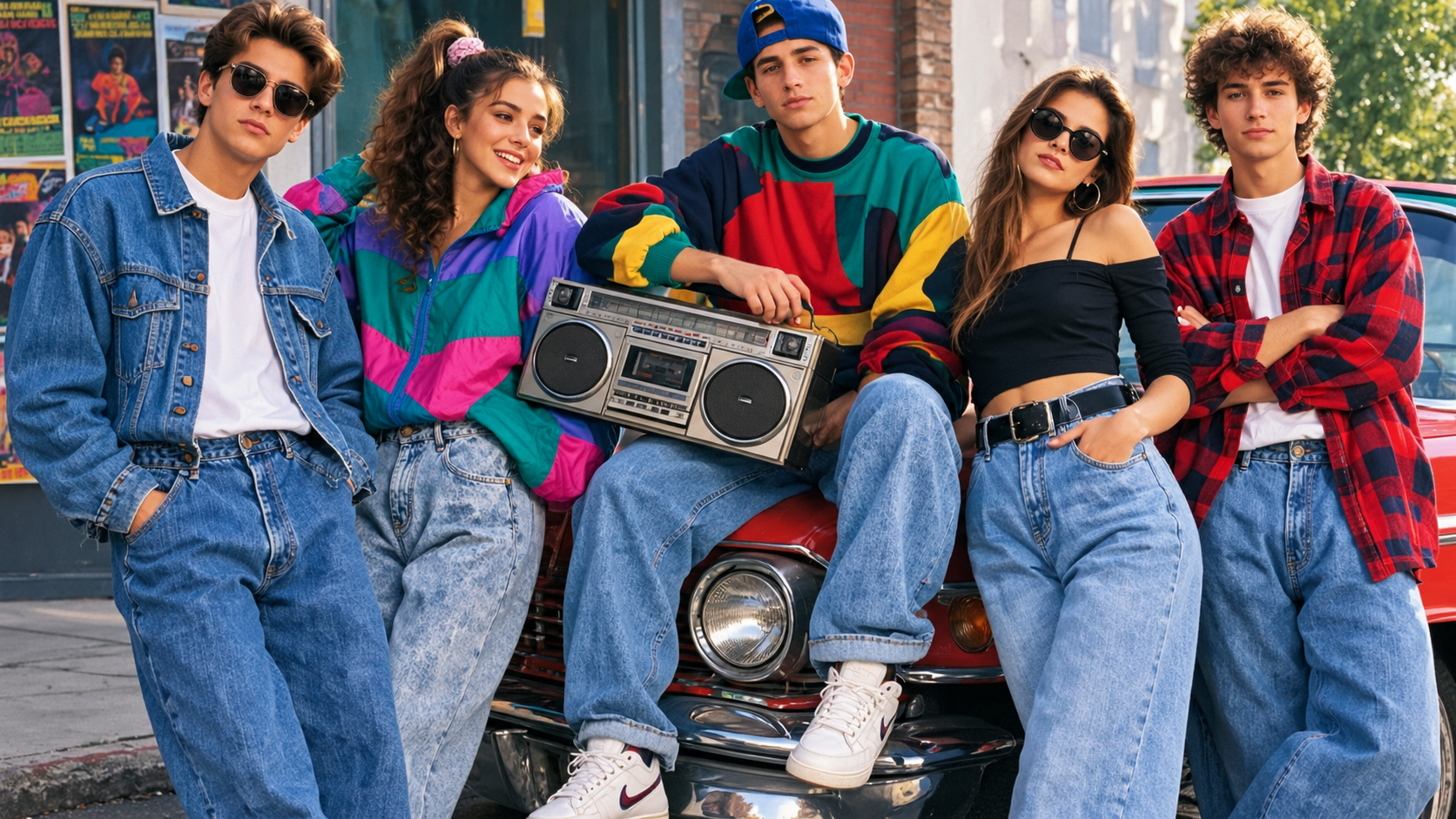
That shift never reversed. We’re still living inside it.
There’s an emotional angle too. A fashion educator quoted in HISTORY’s rundown argues that today’s nostalgia is partly an economic hedge (brands lean on what already worked) and partly a longing for a slower pace. I buy that. Scrolling a phone all day makes a thick cardigan and a pair of beat-up boots feel like a small act of rebellion.
And honestly? The silhouettes are just good. Wide leg, long line, slouchy layers. They flatter more bodies than skinny-everything ever did.
A Year-by-Year Cheat Sheet for 90s Fashion
Before the seven looks, a quick orientation. I find it hard to understand 90s fashion without a rough timeline in my head, because the whole thing swung like a pendulum. Glossy, then scruffy, then sleek, then soft and bohemian.
Here’s the version I keep in my notes app.
- 1990. Madonna wears that famous Jean Paul Gaultier corset on her Blond Ambition tour, and Vera Wang opens her own salon in New York. Supermodels are suddenly household names.
- 1991. Nirvana releases “Smells Like Teen Spirit,” which turns out to matter enormously for what teenagers wear. Vivienne Westwood takes a British design award, too.
- 1992. Marc Jacobs picks up a major American designer award. Remember that, because it gets interesting next year.
- 1993. The Perry Ellis grunge collection. Admired, mocked, career-altering.
- 1994. Tom Ford takes over as creative director at Gucci, which sets up the sleek, sexy look luxury would chase for years.
- 1995. Jennifer Aniston’s “Rachel” haircut spreads around the globe, and Clueless hits cinemas.
- 1996. John Galliano starts at Dior. Womenswear starts drifting toward a bohemian mood.
- 1997. The Fendi Baguette appears and becomes the first real “it bag.” It was also the year Gianni Versace was murdered, and his sister Donatella took over the house.
See what I mean about the pendulum? In seven years we go from corsets to cardigans to cocktail slips. Nobody in the nineties thought it was odd. They just changed their clothes.
One thing I’d highlight: the first half of the decade mostly argues with the eighties, and the second half mostly argues with itself. Understanding that helps you shop, because “90s fashion” printed on a hangtag could mean a flannel from 1992 or a boho skirt from 1998, and those are practically different universes.
Grunge Was Never Meant to Be Fashion
Look number one. And it’s the funniest one, because the whole point was not caring.
Grunge grew out of Seattle in the late eighties, built on thrifted, worn-out everyday clothes. Baggy beat-up jeans, flannel shirts, Doc Martens. Bands like Nirvana and Pearl Jam wore it because it was cheap, warm, and didn’t ask them to perform for anyone. Then the rest of the world noticed and, well, you know what happens next.
Flannel, Docs and Converse
The grunge uniform was almost embarrassingly simple. An oversized flannel, sometimes over a band tee. Jeans with actual holes, not the pre-distressed kind sold in a plastic bag. Beanies. Chunky knit sweaters with weird patterns. Converse if you wanted something light, combat boots if you didn’t.
Kurt Cobain wore cardigans like they were armor. That slouchy, ripped, shapeless thing he did? Still the template.
For women, the formula leaned on slip dresses worn with heavy boots, or babydoll dresses scuffed up with tights and attitude. I love this part. Pretty and rough, at the same time, on purpose.
My honest tip: if you’re copying grunge today, buy the flannel used. New ones are too crisp, too even, and they hang like a costume. A flannel needs to have lived a little.
The Runway Gets Messy
Then came 1993, when Marc Jacobs sent a grunge-inspired collection down the Perry Ellis runway. Critics were horrified. It cost him his job there. It also made his reputation, which tells you something about how fashion works: yesterday’s scandal becomes next decade’s textbook.
What fascinates me is the irony. A look born from refusing to engage with fashion ended up on a runway, then in malls, then in every teenager’s closet by 1994. You can’t keep a thing like that underground once it looks good in photographs.
And it did look good. Slouchy, layered, faintly sad. Pair that with the secondhand shopping boom it kicked off (thrift stores multiplied) and you’ve got one of the most lasting legacies of the entire decade.
Minimalism and the Slip Dress Era
Look number two is grunge’s polite cousin, who showed up to the same party in better shoes and refused to talk about it.
By the mid-nineties, womenswear got streamlined. After a decade of volume and sparkle, designers wanted quiet. Muted colors, clean lines, nothing screaming for attention. It felt like a deep exhale.
One Strap, Zero Fuss
The slip dress is the whole movement in one garment. Thin straps, bias cut, a little silk or satin, falls where it falls. Kate Moss, Gwyneth Paltrow, and Jennifer Aniston all wore versions of it, and it moved comfortably between evening wear and a casual daytime outfit worn over a plain white tee.
That white-tee trick is one of my favorite things the decade gave us. Slip dress over a T-shirt. Instantly sorted, instantly less fancy, instantly wearable on a Tuesday.
I keep steering friends toward a black slip in satin or crepe. It does more work than most “investment pieces” costing triple, and it works with a blazer, a denim jacket, or a boxy knit.
Klein, Karan and Lang
Names to know here: Calvin Klein, Donna Karan, Helmut Lang. Different temperaments, same idea. Quality over decoration, a simple shape done properly.
Lang is the one I’d study if you want to understand why minimalism felt modern instead of dull. He borrowed from parkas and combat trousers, the stuff outdoor adventurers wore, then gave it a cool, sharp edge. That mix of utility and polish is basically half of what we call elevated basics now.
A quick, honest note about the darker side of 90s fashion, because ignoring it would feel dishonest. The “heroin chic” look, popularized through ultra-thin models in down-at-heel photoshoots, drew serious criticism then and deserves it now. I’m happy to borrow the clothes. I’m not interested in borrowing that body ideal. Neither should you.
How Hip-Hop Shaped 90s Fashion
Look number three, and I’d argue it’s the one with the biggest living influence.
Grunge and minimalism hog most of the retrospectives. A fashion educator interviewed by HISTORY said hip-hop deserves equal billing, and she’s right. Look at what’s in a modern streetwear store and you’re mostly looking at hip-hop’s descendants.
Baggy, Branded, Unapologetic
The silhouette was big. Jeans so baggy they pooled at the ankle, hoodies in sizes that bordered on camping equipment, snapback caps, tracksuits, basketball shorts, oversized jerseys. Color was loud. Patterns were louder. Will Smith on The Fresh Prince of Bel-Air wore zany, bright combinations that somehow never looked accidental.
TLC and Salt-N-Pepa leaned into bold colors, playful patterns, and eye-catching accessories. It was sporty, it was high fashion, and it made no apology for being fun.
Labels Built From the Culture
This is the part I wish more people knew. Hip-hop didn’t just wear brands. It created them.
Tommy Hilfiger worked closely with artists, and the heavily logoed casualwear he pushed became a signature of the decade. Meanwhile, Walker Wear (founded by April Walker), FUBU, and Cross Colours were built from inside the culture itself. They didn’t wait for European fashion houses to hand out approval. They made the thing, and the thing sold.
That’s an enormous shift in who gets to decide what’s stylish. Everything about modern streetwear business starts there.
Boots and Jordans
Footwear mattered as much as clothes. Timberland boots, Air Jordans, and Clarks Wallabees were the big three, and they’ve all stayed in rotation for thirty-odd years. Which should tell you something. Trends vanish. Good boots do not.
If you only buy one piece from this look, make it a pair of broken-in boots and wear them with jeans that actually fit. You’ll look sharp, and nobody will say “costume.”
Clueless, Friends and the Preppy Comeback
Look number four came straight off the television. Pop culture was running the show by then. Home computers, cable, and music videos pushed trends in front of audiences faster than any decade before, and plenty of teenagers learned how to dress by watching a sitcom.
Preppy style never really left after the eighties. Khakis, navy blazers, Oxford shirts, all still hanging around for men. Then in 1995 Clueless arrived and made it feel brand new for girls. Plaid skirts, knee socks, tiny cropped sweaters, a mini backpack slung on one shoulder. Costume designer Mona May deserves a whole shelf of awards for that wardrobe.
On the guys’ side, you had two camps. One was the casual khaki-and-white-tee approach, the sort of thing Brad Pitt wore off-duty. The other was the dressy-casual hybrid, where jeans or khakis went under a blazer and nobody tucked anything in. The characters on Dawson’s Creek wore the baggy late-nineties version of this, soft sweaters over loose pants. Not exactly exciting. Very comfortable.
Honestly, this is the easiest 90s fashion look to wear without anybody noticing you’re wearing a “look.” A plaid skirt with a cream sweater and clean boots, and you’re done. A navy blazer over a plain tee with relaxed jeans, same story.
I’ll give you one rule here. Skip the full head-to-toe schoolgirl set unless it’s October 31st. Borrow two elements and let the rest stay normal.
Skate Parks, Gap Hoodies and Easy Sportswear
Look number five is the one your cousin probably wore without ever thinking of it as style.
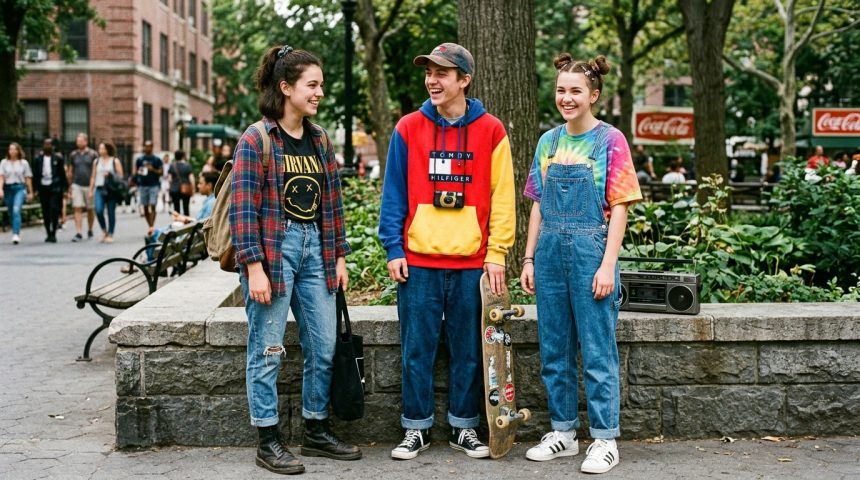
Skate culture went mainstream within 90s fashion, riding on films like Kids and Clueless (yes, again, that movie is everywhere) and music from the Beastie Boys. Baggy jeans, oversized T-shirts, chunky-soled skate sneakers. Girls shrank the tee instead of enlarging it, which gave us the baby tee, though that deserves its own paragraph later.
The part I find most interesting is how normal it became. The Gap, according to the textbook authors cited by FIT, did more than almost anyone to turn hooded sweatshirts and cargo pants into something every age group wore. Cargo pants even helped shrink the denim market for a stretch. Imagine that, a pocket-covered trouser denting jeans.
Sportswear crossed over too. Tracksuits, windbreakers, Champion sweatshirts, baseball caps. Some of that came from hip-hop, some from skate, some just from people wanting to be comfortable while living their lives. By the mid-nineties, urban sportswear had slipped into workplaces, which is a little wild when you think about it.
If you want to wear this look now, the formula is dead simple.
- A boxy hoodie or crewneck in a washed color
- Relaxed straight-leg jeans or cargos with a real pocket
- Flat chunky sneakers
That’s it. No gimmicks, no logos the size of dinner plates.
Mall Accessories That Defined 90s Fashion
Look number six is less an outfit than a drawer full of small things, and I mean that as the highest praise.
Take any boring top, add three tiny accessories, and suddenly you’re in 1997. That’s the power of this stuff. It’s also why I think it’s the safest entry point if you’re nervous about committing to the full aesthetic.
Butterfly Clips in Clusters
Inexpensive, colorful, and cheerfully ridiculous. Butterfly clips pinned back sections of hair near the crown, and people wore several at once. Kirsten Dunst, Sarah Michelle Gellar, and Melissa Joan Hart made them a teen staple, and they showed up everywhere from school hallways to red carpets.
They’ve returned in the last few years. My advice: use two or three, not twelve, and pick a muted shade if you’re worried about looking too young.
Chokers of Every Kind
Chokers weren’t new. They’d been around for centuries. But 90s fashion turned them into a mass-market obsession. Stretchy “tattoo” plastic ones, velvet ribbons, rhinestone strands, leather bands, goth-flavored versions. Even Princess Diana wore one in 1994, a pearl-and-sapphire piece paired with her famous “revenge dress” that year.
A fashion curator quoted in the HISTORY article called wearing one a little bit of drama. I love that framing. A choker is the cheapest way to add drama to a plain neckline.
Tiny Backpacks, Big Impact
The mini backpack was a must-have in early 90s fashion, with Prada’s nylon version and Agnès B.’s style among the most coveted. Clueless gave them another boost, with the main characters cramming phones and school essentials into them.
They’re back, and they’re genuinely practical for a day when you only need a phone, keys, and a lip balm. Just don’t expect to carry a laptop.
Platform Shoes and Slinky Sandals
Platforms returned in 90s fashion too. Vivienne Westwood’s 1993 runway show featured towering ones, and Naomi Campbell famously took a tumble in them. The Spice Girls made sky-high shoes a pop-star signature. At the mall level, it was Steve Madden’s cushioned Slinky Sandal that won over teens.
I’ve walked in platforms for a full day. Worth it, if the sole is soft.
Supermodels, Spice Girls and Pure Glam
Look number seven. Because 90s fashion wasn’t only about looking like you’d just rolled out of bed.
The early part of the decade belonged to the supermodel. Linda Evangelista, Cindy Crawford, Naomi Campbell, and Christy Turlington became more famous than the clothes they wore. When the four walked arm in arm at Versace’s 1991 show, it turned into a moment people still reference. Then the mood shifted toward a thinner, grittier aesthetic, and the glossy era faded.
But glamour never went fully away. It shifted into pop culture. The Spice Girls dressed in strong colors, rave-inspired garments, varsity jackets, platform boots, neon sunglasses. Over-the-top and joyful, with each member projecting a different personality through clothes.
Meanwhile Versace, Gucci under Tom Ford, and Fendi (whose Baguette bag arrived in 1997 as the first true “it bag”) kept luxury sparkling. Jennifer Aniston’s haircut in 1995 got copied worldwide, which proves hair counts as fashion too.
How to borrow this: pick a single glamorous piece. A satin slip. A sleek baguette-style shoulder bag. Sharp, silky separates. Then let everything else stay low-key, and you get the nineties glam effect without the sequins-and-hairspray ceiling.
90s Fashion for Men: Untucked and Unbothered
Most blog posts about 90s fashion lean heavily on women’s looks. Fair enough, there’s more to photograph. But the men’s side of the decade is quietly fascinating, and it explains half of what guys wear now.
The general direction was simple: more casual, every year. Jeans and untucked shirts became ordinary daywear. Music pushed it along, with grunge, hip-hop, and Britpop each pulling men’s closets in a slightly different direction.
The Casual Takeover
In the early part of the decade, the grunge look was basically an oversized flannel (sometimes over a band tee), jeans, beanies, chunky patterned knits, and Converse. By the middle of the decade, grunge cooled off, but the relaxed attitude stayed. Sportswear moved in: baseball caps and jackets, basketball shorts, tracksuits, hoodies.
Then something happened that I find hilarious. Offices gave in. Casual Friday kept widening until jeans and sweatshirts were acceptable in almost any workplace that wasn’t deeply formal. Every guy who’s ever worn a hoodie to a meeting owes something to the late nineties.
Khakis, Blazers and the Dressy-Casual Hybrid
Later in the decade, khakis started competing with jeans. A “dressy casual” look took hold: khakis or jeans with a blazer and a dress shirt, untucked. Brad Pitt’s khakis-and-white-tee combination became shorthand for effortless. And a 1998 Gap commercial for khaki pants turned swing dancing into a fashion moment people still reference.
Preppy labels like Ralph Lauren and Calvin Klein came roaring back around then too. If you’ve ever put a navy blazer over a plain tee and called it “smart casual,” congratulations, you’re doing 90s fashion for men.
Britpop, Rave and Tracksuit Culture
Across the Atlantic, Britpop revived sixties Mod styles, think slim jackets, polo shirts, and parkas. Rave and clubwear, meanwhile, borrowed retro sportswear. Tracksuits and bucket hats weren’t only hip-hop property, and the crossover is a big part of why those items feel so versatile now.
My two cents for men trying this out: don’t go head-to-toe baggy. Take one baggy piece (jeans or an oversized overshirt) and pair it with something fitted. Otherwise you’ll look like you’re borrowing your older brother’s closet, and not in a good way.
Kids, Cartoons and the Olsen Effect
I’d feel dishonest skipping this, because for a lot of us, our first fashion memories are children’s clothes.
Kids’ clothing followed adults’. Flannels, jeans, Gap sweatshirts, and layered looks were everywhere. Boys leaned toward baggy jeans and loose shirts, often layered. Sportswear mattered too: Champion sweatshirts, track jackets, and team gear in full logo glory.
Then there was Disney. Early-to-mid-nineties animated hits like The Lion King, Aladdin, Beauty and the Beast, and The Little Mermaid ended up printed across t-shirts and sweatshirts. If your childhood closet didn’t have at least one cartoon top, I’m not sure we grew up in the same decade.
Mary-Kate and Ashley
For girls, the twins were practically a fashion magazine. Early on they wore matching outfits and overalls. As they grew, their style split: Mary-Kate gravitated toward pants and tomboy outfits, Ashley toward dresses and skirts. That let young fans see themselves in either one. By the end of the decade, the twins even had their own clothing line at Walmart.
Babydoll dresses were a favorite for young girls in the early years of the decade too, which circles back to an odd truth about 90s fashion: kids dressed like grown-ups, and grown-ups dressed like kids. It was a very strange, very fun feedback loop.
The Bohemian Turn in Late 90s Fashion
Most people forget this part. The decade didn’t end in grunge or even minimalism.
From about 1996 onward, a bohemian mood took over womenswear at nearly every price level. Embroidery, mixed fabrics, Eastern influences, and a love of seventies references. Designers like Dries Van Noten (known for his adapted embroideries), Matthew Williamson (with a bold sense of color), and houses like Marni and Fendi mixing fabrics in playful ways helped define it.
And the decade’s final gift? Low-slung jeans and crop tops, the hallmarks that carried straight into the 2000s.
I think of this as the “bonus eighth look” of 90s fashion. It doesn’t get its own number because it doesn’t fit neatly with the rest, but if you love flowy skirts, embroidered tops, and mixed prints, this is your corner of the era.
How to Wear 90s Fashion Today Without the Costume Effect
Okay. This is the part most people actually came for.
I’ve seen it go wrong more times than I can count. The usual story: someone buys every 90s fashion piece in one trip, wears them all at once, and ends up looking like a mannequin in a retro-themed café. The decade is not the problem. The quantity is.
For a fresh look at how this revival has been playing out on actual runways, Highsnobiety’s breakdown points to several Milan Fashion Week shows that went all-in on nineties tailoring and minimalism. Designers aren’t dressing people as museum exhibits. They’re remixing.
Pick One Hero Piece
My number-one rule for wearing 90s fashion in daily life: one 90s fashion item per outfit. Just one.
A slip dress, a baby tee, a pair of baggy jeans, a flannel, a choker, whichever you like. Everything else stays modern. That contrast is what makes it look chosen instead of costumed.
Let Fit Do the Talking
Clothes in 90s fashion were defined by shape. Loose, long, slouchy, boxy. If you buy modern versions but get the proportions wrong, you’ll feel like you borrowed someone else’s wardrobe.
A few reliable pairings:
- Baggy jeans with a fitted top or crop top, plus sneakers
- Baggy jeans with a tucked-in structured button-up and heeled boots
- Oversized blazer with biker shorts or slim trousers
- Slip dress over a white tee with chunky shoes
Notice the pattern? Big on one half, closer on the other. Never big all over, unless you’re deliberately going for the full skater look.
Mind Your Proportions
Some details date quickly. Low-rise maxi skirts, thin plucked brows, ultra-low waistbands. Skip them. Today’s versions sit higher on the waist and finish near the ankle, which feels fresher.
Denim That Works Now
Straight or wide-leg, mid to high rise, darker wash if you want it to look intentional. Light acid wash needs confidence. Double denim works, but separate the shades slightly, one lighter and one darker, so it looks like a decision.
Outerwear Worth Having
A leather jacket (slightly distressed, never shiny new), an oversized denim jacket, a quilted utility vest. All of them layer over the simplest outfits and instantly shift the mood.
Keep Colors Earthy
Palettes in 90s fashion were often muted and earthy: olive, rust, mustard, faded black, cream, deep plum. Neutral dressing, basically, with a few loud exceptions. Stick to that and your outfit will read as vintage-inspired instead of themed.
A Starter 90s Fashion Capsule That Actually Works
If you want to dip a toe without buying a whole new closet, this is the list I’d hand a friend. Nine pieces. Mix and match them with whatever you already own.
- A black slip dress. Over a tee for day, alone for evening.
- Straight or baggy jeans. Dark or mid wash. The single most versatile piece on this list.
- A broken-in flannel. Thrifted, ideally.
- A plain white tee or a baby tee. Fit is everything.
- A denim jacket. Slightly oversized.
- A leather jacket. Distressed, never shiny.
- Chunky boots. Docs, combat boots, or a Timberland-style boot.
- An oversized blazer. Wear it with jeans, with a slip, with anything.
- One simple choker. Velvet or leather. Not twelve.
Honestly, five of those are probably already hanging in your closet. The other four, you can usually pick up secondhand for the price of lunch.
What I love about this setup is how little thinking it needs. You can build a dozen outfits without opening a single trend report. And because the pieces are classic shapes rather than gimmicks, your 90s fashion capsule won’t feel dated in six months.
Wearing 90s Fashion in Every Season
90s fashion happens to be quietly seasonal-proof. Layering was huge back then, and layers are what make an outfit travel across the calendar.
Warm Weather Combinations
A baby tee with loose cargo pants and flat sandals. A slip dress over a thin white tee with sneakers. A boxy button-up, sleeves rolled, over a tank and wide-leg shorts. Jelly sandals (the modern ones are considerably more comfortable than the originals) are the sort of small detail that makes an easy summer outfit feel playful.
Cooler Weather Layers
This is where 90s fashion shines. Flannel over a tee, chunky cardigan over that, boots on the bottom, beanie on top. Add a utility vest or oversized denim jacket and you’ve built something warm, textured, and thoroughly 1993.
In-Between Days
A lightweight windbreaker over a hoodie. A slip dress with a chunky knit draped over the shoulders. Wide-leg trousers with a fitted long-sleeve. If you can only afford one thing for shoulder seasons, make it a good oversized blazer.
Five Outfit Formulas to Copy This Week
Theory is nice. Outfits are better. Here are five recipes I’ve tested on myself and on stubborn friends, each built around a single piece of 90s fashion and everything else kept ordinary.
1. The lazy grunge morning. A thrifted flannel tied loosely at the waist, a plain white tee, straight jeans, scuffed boots. Ten minutes, tops. The flannel is your 90s fashion moment, and nothing else needs to try.
2. The slip-and-tee. A satin slip dress over a fitted white tee, chunky sneakers, a small shoulder bag. It looks dressy and relaxed at once, which is the entire point of the dress.
3. The grown-up Clueless. A plaid mini or midi skirt, a soft cream sweater, ankle boots. Skip the knee socks unless you’re feeling brave. It’s 90s fashion for people who have meetings.
4. The skate-park errand run. A boxy hoodie, relaxed cargo pants with proper pockets, flat sneakers. Add a bucket hat if you like. Comfortable enough to carry you through a grocery trip, a long walk, and an unplanned coffee.
5. The quiet power move. An oversized blazer, white tee, wide-leg trousers, loafers. This one nods to the minimalist side of 90s fashion, and it’s the outfit I wear most when I want to look put together without looking like I tried.
Notice something? None of these needs a head-to-toe shopping spree. Each one lets a single piece speak, and each one works with clothes you probably already own. That’s really the whole philosophy of wearing 90s fashion in daily life: edit, don’t pile on.
If you only try one, make it number two. The slip-and-tee has converted more skeptics than any lecture I’ve given.
Thrifting Real Vintage Without Wasting Money
Reproduction pieces are fine. But there’s a particular pleasure in wearing something that actually lived through the decade, and real vintage is often better made than what’s on the rack today.
Where I Look First
Charity shops, flea markets, estate sales, and the men’s section of any secondhand store. Seriously, the men’s section. That’s where oversized flannels, boxy denim jackets, and broken-in jeans hide. Online resale platforms are great too, but search with specific terms (like “90s Levi’s 501” or “vintage Champion crewneck”) and you’ll skip pages of junk.
Also ask family. A parent’s or an older relative’s closet can be a goldmine. Mine delivered a corduroy jacket that I still wear every autumn.
Quick Quality Checks
Before buying, run through these:
- Smell it. Musty is fixable, mildew is not.
- Check the seams at the underarms and crotch, where wear shows first.
- Look at the tag. Tags from the 90s fashion heyday often show made-in-USA labels and older fonts, and the fabric tends to be heavier.
- Try it on. Vintage sizing runs wildly different. Trust the fit, not the number.
- Inspect zippers and buttons. Easy to replace, but factor in the effort.
Don’t be scared of minor flaws. A tiny hole in a flannel is basically part of the aesthetic.
What 90s Fashion Taught Me About Dressing Well
I didn’t plan to learn life lessons from old flannels. But here we are.
Comfort and style aren’t enemies. For years I assumed looking good meant putting up with something pinching or itching. Then I spent a season dressing almost entirely out of 90s fashion, and realized the best outfits of the decade were the ones people could actually move in. Nobody’s slouchy cardigan was strangling them. Lesson learned.
Used beats new, most days. A jacket that’s been worn in for thirty years has a softness you can’t manufacture. Brands try (and charge a lot for it). Thrift stores just hand it over.
Repetition is a style. Cobain wore cardigans and flannels again and again, and it became his look. People remember consistency. If you love a certain silhouette, keep wearing it. Let it become yours.
Contrast is the secret. Slip dress plus boots. Flannel plus satin. Baggy jeans plus a tiny top. Whatever you’re borrowing from 90s fashion, pair it with something unexpected and you’ll avoid the costume trap nearly every time.
Perfect is boring. The decade’s most beloved outfits were slightly undone. Hair half-clipped, sleeves too long, sweater a little stretched. I wish more modern fashion allowed for that kind of looseness.
None of this is revolutionary. But it’s remarkable how often I catch myself returning to those ideas when I stand in front of a messy closet.
90s Fashion Myths I’d Love to Retire
I hear the same few assumptions every time someone asks me about the decade, and honestly, most of them are wrong.
“It Was All Baggy”
Not even close. Plenty of 90s fashion was fitted: baby tees, slip dresses, cropped sweaters, bike shorts. The skate and hip-hop looks leaned oversized, and minimalism was streamlined. Calling all of 90s fashion “baggy” flattens a decade that was actually playing with proportion constantly.
“It Was Cheap and Careless”
Grunge pretended not to care, sure. But designers like Helmut Lang, Calvin Klein, and Donna Karan built high-quality, carefully cut clothing, and luxury houses like Gucci and Versace were doing their most memorable work. There was craft underneath the slouch.
“It Belongs Only to Teenagers”
Look at who actually wore the best minimalist pieces: grown women in tailored slips and sleek coats. Look at who wore preppy looks: adults in navy blazers and khakis. 90s fashion was for everyone, and that’s part of why it adapts so easily today.
“You Can’t Wear It to Work”
Wrong again. The decade is partly responsible for the relaxed modern office. A slip dress under a blazer, wide-leg trousers with a fitted knit, a crisp shirt untucked over straight jeans. These are all perfectly fine workwear, in all but the strictest industries.
“It’s Just a Trend”
Trends fade. The foundations of 90s fashion, casual dressing, streetwear culture, minimalism, secondhand shopping, simply never left. They became the baseline. That’s why the revival feels natural instead of forced.
Mistakes I Keep Seeing
I’ll be blunt here, because I’d rather you hear it from me than from your own mirror.
Wearing everything at once. We covered this, but it deserves repeating. A butterfly clip, a choker, a baby tee, platform sandals, and a mini backpack together reads as a Halloween costume. Pick two, maximum.
Buying “distressed” jeans with fake damage. Factory-made rips tend to look too even, too deliberate. Thrift real worn jeans or let yours age naturally.
Ignoring the underlying fit. An oversized item only looks cool if it’s intentionally oversized. If the shoulders hang past your elbows, size down.
Treating 90s fashion as a single aesthetic. Grunge and minimalism were basically opposites. Mixing a ripped flannel with a delicate satin slip works beautifully (the era did it too). Mixing five conflicting looks does not.
Forgetting hair and shoes. A modern, over-styled blowout kills a 90s fashion outfit. Chunky shoes or clean sneakers bring the whole thing together.
Where 90s Fashion Goes From Here
Will the revival last? I honestly don’t know, and I’ve stopped trying to predict it. Every few seasons somebody declares 90s fashion “over,” and every few seasons a runway show proves them wrong.
My hunch is that the clothes will keep surviving for the boring reason I mentioned at the start: they’re easy. Fashion cycles reward things people actually enjoy wearing, and nobody ever fell in love with an uncomfortable trouser. The decade also gave us ideas bigger than any single garment. Secondhand shopping as a statement. Streetwear as a legitimate business. Minimalism as a quiet kind of confidence. Those ideas have outlived the specific outfits.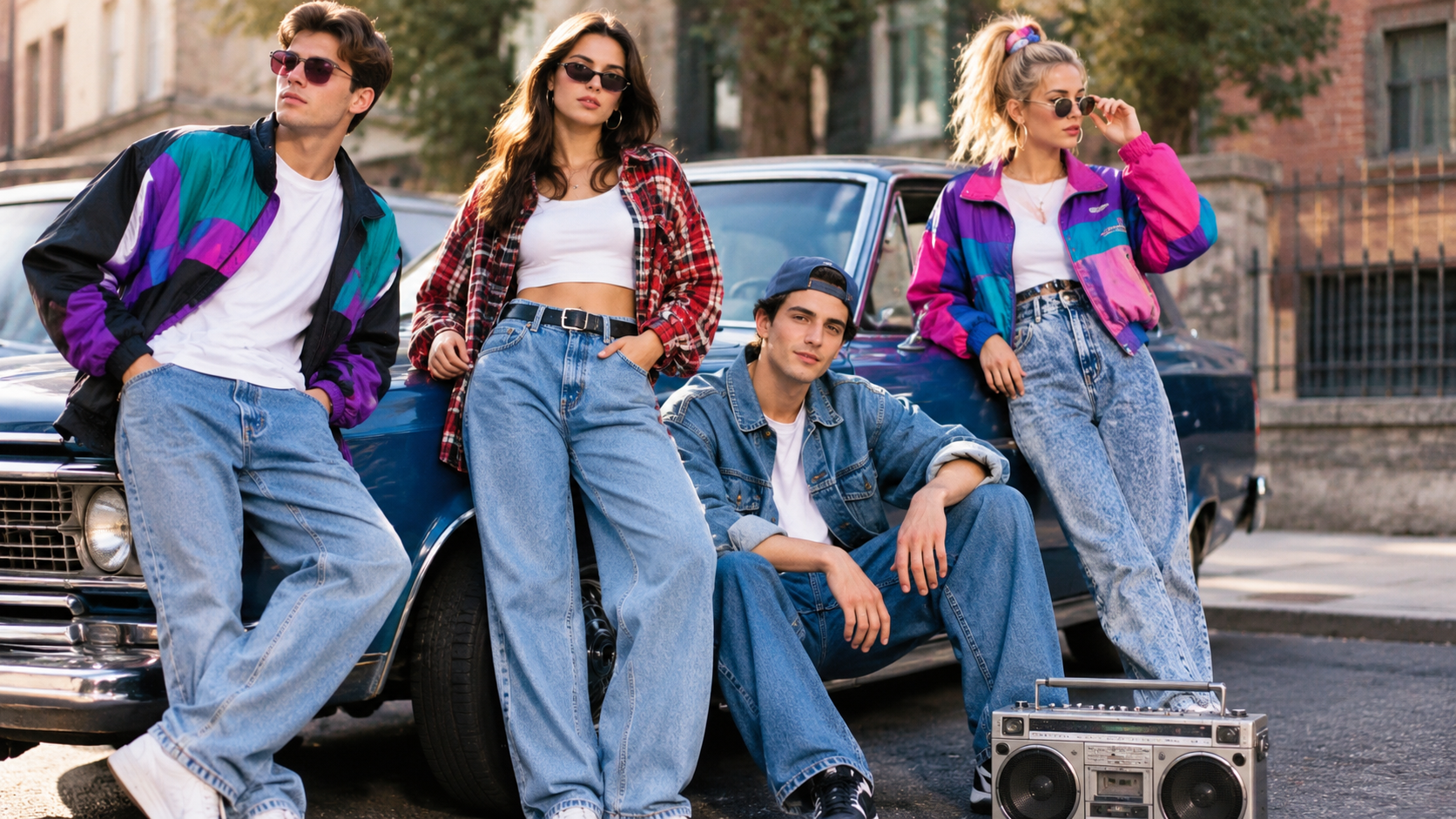
What I’d watch for next is a shift away from straight-up imitation. The most interesting designers right now aren’t copying 90s fashion, they’re arguing with it, stretching the proportions, swapping the fabrics, mixing grunge slouch with sharp tailoring. That’s healthy. A style that can only be replicated is a costume. A style that can be reinterpreted is a language.
And for those of us getting dressed in the real world, the practical takeaway doesn’t change. Buy fewer, better pieces. Thrift when you can. Keep one foot in the past and the other firmly in this decade, and 90s fashion will keep rewarding you for it.
FAQs
What defined 90s fashion most? A mix of grunge, minimalism, hip-hop streetwear, preppy looks, and skate or sportswear, all existing side by side. The common thread was casual comfort and a loose, relaxed fit.
Is 90s fashion still in style right now? Yes. Baggy jeans, slip dresses, cargo pants, flannels, and platform shoes keep returning in modern collections, usually updated with better fabrics and cleaner proportions.
How do I wear 90s fashion without looking dated? Stick to one 90s fashion statement piece per outfit and keep the rest contemporary. Pay attention to fit, choose earthy or neutral colors, and skip the heavy accessories all at once.
What are the essential 90s wardrobe pieces? Baggy jeans, a slip dress, a flannel shirt, a baby tee, a denim jacket, combat boots or Timberlands, and a choker. Those few items cover most of 90s fashion.
Where can I buy authentic 90s clothing? Thrift stores, flea markets, estate sales, and online resale sites are the best bets. Search specific terms like “vintage Levi’s 501” and check seams, tags, and smell before buying.
Final Thoughts
I keep coming back to how little 90s fashion asked of us. Throw on the flannel. Wear the boots. Let the jeans be too long. There’s a generosity in that style that I don’t see much in the trend cycles that came after it, and maybe that’s why it keeps returning.
So here’s my nudge. Don’t rebuild your closet. Open it. Find one old thing, a denim jacket, a slip, a faded tee, and wear it this weekend with something totally current. See how it feels.
And if you thrift a great piece this month, tell me about it. I’m always up for a good flannel story. Happy hunting, and may your jeans always be a touch too baggy.