




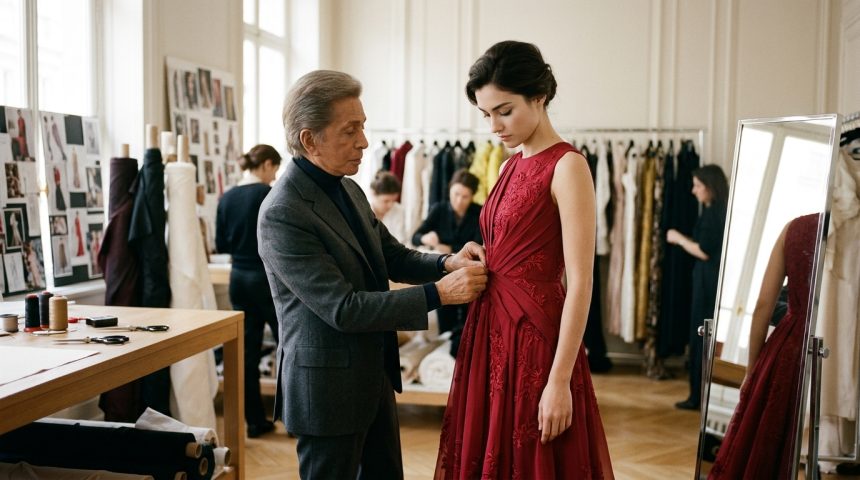
Valentino is much more than a brand. It’s an emotion. Looking at the images from Valentino’s archives, I learn something new every time. Everything is carefully designed. This is a designer who knows exactly how much beauty they can add to a design without it becoming too much.
Valentino Garavani really understood the balance.
Valentino Garavani was a brand that was built around one main idea. Women deserve pieces that they can wear to make their everyday feel a little more special. Not full on costume pieces but pieces that make them feel taller once they walk into a group of people who are already judging them.
He passed away in January 2026 aged 93. However, his design has not faded away. In fact it is one of the few fashion houses whose design is continuously used, argued and modernised by new generations.
This shows a real influence.
Who Was Valentino?
Valentino Clemente Ludovico Garavani was born on the 11th May 1932 in Voghera, a small Northern town of Italy, situated between Turin and Milan. He became known worldwide simply as ‘Valentino’, which is something many designers can never achieve.
Just Valentino.
Just one name. One aesthetic. One shade of red.
At 17 he left home to go to school to learn everything about fashion. First in Milan and then Paris at the École de la Chambre Syndicale de la Couture Parisienne. He learnt to create perfect couture pieces. However, Italy gave him the confidence to create luxury pieces that felt more warm.
He returned to Rome in 1959, opening his first atelier on Via Condotti. The same year he launched his first haute couture collection, named Ibis. A year later he officially formed Maison Valentino with Giancarlo Giammetti, an architecture student who became the business and strategic side of Valentino Garavani.
This partnership was extremely important.
A designer may have a beautiful eye. But without someone who understands factories, boutiques, licenses, customers, money and that it takes more than beauty to pay the rent. Giammetti provided that.
The Perfect Partnership
What I find fascinating about this partnership is that Valentino and Giammetti were also in a romantic relationship for about a dozen years. Even after their relationship ended they continued to build up their company.
This could have been a disaster. However, it shows how true passion can be.
As Valentino was the visionary and Giammetti the map maker, they created a stunning luxury house from just an atelier in Rome. With boutiques in Paris, Milan, New York, London and Tokyo.
I have noticed that in fashion history people tend to talk about the person with the scissors and forget about the person with the spreadsheets. Most luxury houses aren’t run by one genius, they’re run by two people who are passionate about the same thing and split responsibilities.
Valentino’s Red
You can’t talk about Valentino without talking about his red.
Valentino red is a specific shade of red made with a mix of carmine, scarlet and a hint of orange. It became his life long signature. He is reported to have included at least one red dress in every collection.
This is a rule.
Red is a tricky colour. It can look cheap depending on the fabric. It can be overwhelming. It can feel desperate, aggressive and over the top. However, with Valentino it became a composed colour with class.
A Valentino red dress will never shout:
“Look at me!”
It just knows you’re looking.
Why It Works
The reason it works is because it photographs well. It flatters everyone’s skin tone. It creates an instant focal point with the runway lighting and flash.
However, it also works because Valentino used it so often. It became a symbol. There was no need for a logo or explanation, you knew instantly that it was a certain shade of red.
This is some of the prettiest branding.
The first red dress (often called the Fiesta dress) was launched in 1959. It was a strapless cocktail dress inspired by a woman he saw wearing red at the Barcelona Opera (Britannica). This is how the red became synonymous with his name.
I love this because it was purely from passion. He saw a stranger wearing red and felt something. This feeling continued throughout his career.
Rome Added The Attitude
Whilst Valentino was taught in Paris, he was created in Rome.
Rome has a certain amount of beauty. It’s grand but has character. It’s dramatic and has an air of luxury. It’s a city filled with beautiful stone, amazing espresso bars and glamorous ladies walking around on cobble stones in shoes they probably shouldn’t be wearing.
Valentino’s pieces have this same character.
They are elegant but not fake. Romantic but not naive. They know when to be appropriate.
Their history shows this. The first atelier was opened on Via Condotti and Rome became the heart of the brand.
Jet Set Chic
Valentino’s style was described as jet set chic (Britannica). This is something that I believe captures the essence of Valentino.
These were pieces for women who lived an active life, attending dinners, getting photographed and giving interviews. However, they didn’t want to look messy at breakfast. These pieces weren’t basic.
In fact, they could be incredibly beautiful. Whilst they looked like fantasy, they had incredible details. Boning, draping, structure and hand finished details. This is what I admire the most.
Luxury is all about control. The lines, movement, weight and details.
The White Collection Changed Everything
Ironically, the man famous for his red became famous worldwide thanks to white.
In January 1968 he launched a haute couture collection focused around white, ivory and beige. This was a huge contrast to the psychedelic styles of the time. It became known as the White Collection. This earned him the Neiman Marcus Award and put him firmly on the map.
That same year Jacqueline Kennedy chose Valentino to wear on her wedding to Aristotle Onassis. She then received 60 orders for the same dress.
60!
This wasn’t just a celebrity moment. This was a huge business moment.
Why It Was So Calm
The late 60s were a loud time. Patterns were loud, hems were short and everything felt like it was trying to prove something.
Valentino provided clarity. It was soft and gave a sense of safety. People loved it because sometimes the most radical thing you can do in fashion is go back to basics.
I always think the White Collection proves that you don’t need to sacrifice beauty to be modern. Sometimes modern is about simplifying.
This collection also introduced the V logo. Another sign that the brand understood everything about their identity.
Celebrity Status
Valentino had a connection with celebrities from the start.
Elizabeth Taylor discovered his work whilst filming Cleopatra in Rome. She ordered a white column dress for the Spartacus premiere. Jacqueline Kennedy became one of his most important clients. Wearing Valentino for both public mourning and private celebration.
Later Audrey Hepburn, Grace Kelly, Sophia Loren, Princess Diana, Julia Roberts and Cate Blanchett.
This is a list of people who have worn Valentino throughout the decades.
Why They Continued To Wear It
Sometimes celebrity can be a downfall for a designer. If everyone famous is wearing your clothes it can feel like a uniform.
However, Valentino’s pieces had character so they weren’t affected by this.
Whilst they photograph well (the colours, lines and details), they also move well. This is something people don’t realise.
The best red carpet fashion isn’t the most detailed, it’s the pieces that look like they have life. When someone is walking, turning, laughing or leaning into the camera.
Valentino knew this.
His silk, chiffon, satin and structured pieces were designed to make you arrive with style.
Skilled Craftsmanship
Looking at Valentino’s work you would instantly think of luxury. The embroidery, beading, silk and dramatic pieces.
However, the real luxury is the work.
Valentino had incredible craftsmanship. His draping and attention to detail showed he truly understood the codes of Parisian couture. The ateliers in Rome also trained many generations of skilled artisans.
This is what I love.
A designer may create beautiful pieces but a designer will create a system that will continue to create beautiful pieces for you.
What Couture Really Means
Couture isn’t just expensive. It involves many skilled people. Pattern cutting, toiling, fitting, embroidery, beading, finishing, pressing and adjusting.
Valentino came from this world. He didn’t see craftsmanship as a background to his concept. He saw it as his concept. This is why his pieces still feel real. There is nothing fake.
The Business Side
Fashion writing always focuses on the catwalk and forgets about the spreadsheets. This is a big mistake.
Whilst a designer may be incredible, if they don’t have a solid business behind them they will disappear. Valentino’s story was about business as much as couture.
In 1998 he sold the company to the Italian conglomerate HdP for around $300 million. However, he continued as the designer for another decade. The house has changed hands many times. Marzotto, Permira, Mayhoola and Kering bought a 30% stake in 2023 with plans to fully buy the house by the end of the decade.
Whilst this is a complex business history it shows that the brand was still valuable.
Why The Name Still Exists
Valentino didn’t just create products. He created recognition.
Red, bows, lace and the V logo. Romantic evening wear and Roman glamour. These were assets.
When a fashion house has clear codes it can survive changes in leadership. New designers can use the language.
After Valentino Retired
Valentino retired in 2008 after his final haute couture show. The house entered a new era with Maria Grazia Chiuri and Pierpaolo Piccioli becoming co creative directors.
Chiuri left in 2016 to join Dior. Piccioli continued as sole creative director, creating a softer, modern take on Valentino’s romantic style. He left in 2024 and Alessandro Michele became creative director in 2024. Taking charge of the womenswear, menswear, accessories and haute couture.
Each era have taken the founder’s legacy in different ways.
Some have stuck to the classic glamour whilst others have pushed towards youth culture, maximalism, streetwear and sleek modern silhouettes. Purists complain.
However, I don’t think a living fashion house should become a museum.
A museum is a place to preserve. However, a fashion house needs to sell, provoke, adapt and sometimes annoy.
How To Create A Lasting Legacy
The best heritage brands don’t put their founder in a time capsule. They adapt.
Valentino has strong codes. The red can become a sharp suit, the bows can be oversized and ironic and the florals can be dark and strange. Whilst keeping the reference it has transformed.
How Valentino Can Teach Us About Modern Style
You don’t need couture money to learn from Valentino.
Honestly the biggest thing I have learned from Valentino is about having passion.
Pick one thing you love. Wear it constantly. Become known for it.
Whether it be a colour, silhouette, type of shoe/bag/jewellery etc. Don’t copy Valentino’s red, create your own.
Top Tips From Valentino
Pick one signature and stick with it. Having one recurring detail will create your own style quicker.
Focus on movement. If your pieces don’t move well they’re not finished.
Make one statement. If your dress is loud keep the accessories simple.
Focus on structure. Often a simple well cut piece will be better than something complicated.
Don’t be afraid to be romantic. A bow, floral or soft colour can be powerful if the rest of your look is disciplined.
This isn’t advice from a glossy magazine. This is what happens when you study people who dress with intention.
The Emotional Side
Fashion can get very technical. The silhouettes, ateliers, creative directors and revenue. Whilst this is all important, fashion is very emotional.
Wedding dresses bring back memories of a day. Red dresses bring back memories of a night where you felt fearless. Coats can bring back memories of a city, person or version of yourself you thought you had lost.
Valentino understood this better than most.
His pieces weren’t trying to fix a problem. They were trying to make you feel something. Like you arrived somewhere, it was appropriate and you transformed.
This is why people still care.
Why Valentino Still Matters
Fashion can get confused about what makes something relevant.
Trends come and go fast. Algorithms faster. Every season people are saying one aesthetic is dead and another is back. However, Valentino’s work isn’t based on a trend. It was based on a point of view.
He believed in beauty. Not irony, shock or minimalism as a personality test. Just beauty.
This sounds simple but it’s not.
The Takeaway
If I was to take one thing from Valentino’s career it would be to become known for one thing.
One colour, attitude, silhouette or feeling.
Repeat it and the world will know instantly.
Valentino did this with his red but also with the idea that fashion should make you feel like your life is more special. Even a daytime piece can have a little more appropriateness.
This is why his work still feels alive. It doesn’t try to be relevant, it just won’t be irrelevant.
Valentino’s Design Codes
There are so many design codes to Valentino. Once you know them you’ll start spotting them everywhere.
Red. The most famous design code. Tied to Valentino Garavani.
Bows. Not cute, but architectural. They have confidence.
Florals and embroidery. Often busy but can be delicate.
Fluid evening wear. Made with silk, chiffon and satin.
Elegant. Not costume like.
I always think Valentino’s elegant style is interesting as it doesn’t apologise. It isn’t trying to be soft. It can be romantic but powerful.
This is where the magic happens.
The House After Valentino
A fashion house is a strange creature. Whilst it has the DNA of the founder it needs to continue to breathe.
Since Valentino Garavani stepped down from the brand Valentino has changed creative directors and ownership. Some have been closer to his classic romance whilst others have pushed towards youth culture, streetwear and sleek modern silhouettes.
Purists complain.
However, I don’t think a heritage brand should become a museum. A museum is to preserve. A fashion house needs to sell, provoke, adapt and sometimes annoy.
The best Valentino we have now has kept enough of the founder’s elegance but has adapted to speak with a modern voice.
How Valentino Can Teach Us About Modern Style
You don’t need couture money to learn from Valentino.
Honestly the biggest thing I have learned from Valentino is about having passion.
Wear the colour everyone says is too much. Pick one beautiful detail. Buy less but pick pieces that have presence. Give your outfit an opinion.
Top Tips
Pick one signature to work around. Whether it be a colour, silhouette, fabric or accessory.
Pick pieces that move. They should work with you when you walk, sit, dance and live.
Don’t be afraid to be romantic. A bow or floral can be sophisticated if the rest of your look is disciplined.
Invest in structure. A simple dress with great structure will beat something complicated that fights against you.
Pick one piece to be the star. If your dress is dramatic keep everything else simple.
This isn’t advice from a magazine. This is what happens when you study people who dress with intention.
The Emotional Side
Fashion can get very technical. The silhouettes, ateliers, creative directors and revenue. However fashion is very emotional.
Wedding dresses bring back memories of a day. Red dresses bring back memories of a night where you felt invincible. Coats can bring back memories of a city, person or version of yourself you thought you had lost.
Valentino understood this better than most.
His pieces weren’t trying to fix a problem. They were trying to make you feel something. Like you arrived somewhere, it was appropriate and you transformed.
This is why people still care.
FAQs
Who was Valentino in fashion?
Valentino Garavani was an Italian couturier who founded Maison Valentino in Rome in 1960. He became famous for his glamorous, precise