



London Fashion Week 2026 recap: McQueen’s homecoming, a royal front row, two very different Burberry nights, and how to follow the next one.
Okay, so London Fashion Week 2026 is officially behind us, and I’ve spent the last few weeks going back through coverage, livestream clips and designer notes trying to work out what the year actually meant. Not what the press releases said. What it meant.
Short answer? London stopped apologising for itself.
The longer answer needs chai. Go make some, I’ll wait. This is a long one.
There were two editions, February and September, and they couldn’t have felt more different. February had a king in the front row and a Burberry show built around a replica of Tower Bridge wrapped in scaffolding. September had McQueen coming home after about twenty-five years away.
In between, you get a runway staged like a school sports lesson, a mini golf course, a bowling alley and a Victorian swimming bath turned skate park. That’s a lot of personality for a city that people used to treat as the warm-up act of fashion month.
I never bought that take, by the way. And London Fashion Week 2026 is the year I’d point at if you asked me to prove it.
Here’s how I’m going to do this with London Fashion Week 2026. First the structure of the year, then each season, then the clothes, the street, the money, and finally how you can follow along from your sofa (or your actual city) without an invite. Opinions included. You didn’t ask, but you’re getting them.
Two Weeks, One Very Long Year
Let’s get the logistics of London Fashion Week 2026 out of the way, because people mix them up constantly.
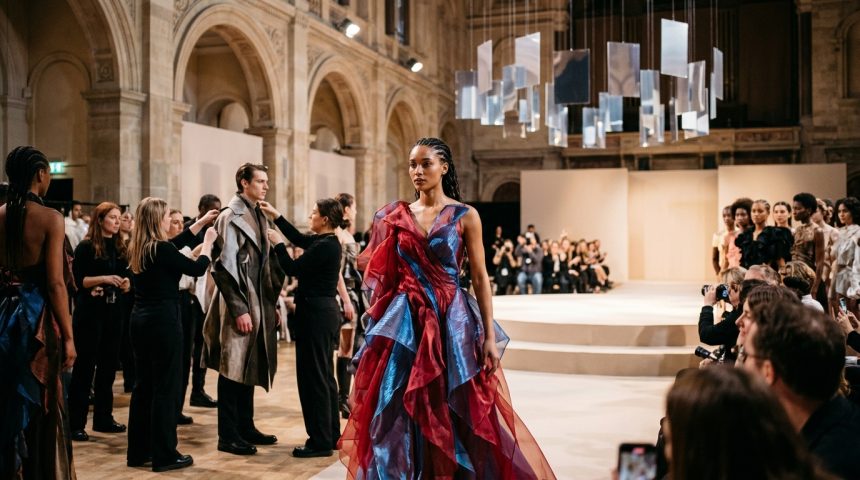
London Fashion Week 2026 happened twice. The first edition ran Thursday 19 to Monday 23 February and showed the autumn/winter 2026 collections. The second ran Thursday 17 to Monday 21 September and showed spring/summer 2027. Same five-day shape both times, same home base at 180 The Strand, and shows sprinkled across the rest of the city like confetti nobody bothered to sweep up.
The September edition came with proper numbers. According to the British Fashion Council’s official press release, the programme had 47 catwalk shows, 23 presentations, 10 digital activations and 53 evening events. That’s a lot of schedule for five days. Nobody sees all of London Fashion Week 2026. Not the editors, not the buyers, definitely not me.
The Calendar Context
Fashion month runs New York, London, Milan, Paris, in that order. London sits second, which is both its blessing and its curse. People arrive jetlagged and slightly raw from New York, then leave for Milan before they’ve fully figured London out. London Fashion Week 2026 didn’t change that order, but it made the stop a lot harder to ignore.
London Fashion Week 2026 was also the shortest stop, and a lot of the action landed on the weekend. I’ve always thought that helps. When the week feels compressed, the city has this slightly feverish energy, like everyone’s trying to fit a month of ideas into a long weekend. Which, honestly, is a pretty accurate description of how British designers work.
Why 2026 Felt Different
The BFC under its relatively new chief executive Laura Weir pushed a “designers first” line pretty hard. In February she said so in the opening speech, and the actions backed it up: show fees waived for designers presenting physically on the main schedule, and the international guest programme doubled in investment. More on that in the money section, because it matters more than the champagne does.
What I noticed, following London Fashion Week 2026 from both seasons, is that confidence is a hard thing to fake on a runway. By September it wasn’t being faked. A heritage house had returned, a historic accessories brand had changed creative hands, and a high street giant had shown up with its own catwalk collection. I’ll get to all of it.
Dates and Numbers at a Glance
If you just want the cheat sheet, here it is.
- February edition of London Fashion Week 2026: Thursday 19 to Monday 23 February, autumn/winter 2026 collections.
- September edition of London Fashion Week 2026: Thursday 17 to Monday 21 September, spring/summer 2027 collections.
- September programme: 47 catwalk shows, 23 presentations, 10 digital activations and 53 evening events.
- Main hub: the BFC’s show space at 180 The Strand, near Holborn and Temple tube stations.
- Opening act in February: Tolu Coker, with King Charles III in the audience.
- Closing acts: Burberry on 23 February and again on 21 September.
- Big return: McQueen, showing in London for the first time in over twenty-five years.
- First-timers on the main schedule: M&S, Lovebirds, and Selasi, which had shown at special events before but not on the official schedule.
- Official partners in September: Blank Street, eBay, Hu Bing Selects, Lee Kum Kee, the Mayor of London, Pandora, The Londoner and TONI&GUY.
Keep that list somewhere handy. When someone at dinner asks what happened at London Fashion Week 2026, you can sound very informed for about ninety seconds.
February: A King, a Tower Bridge and a Lot of Drizzle
February set the tone before the first model had even walked. London Fashion Week 2026 opened with a royal cameo, and I mean that literally.
The Royal Front Row
On the Thursday afternoon, King Charles III attended the autumn/winter show of British-Nigerian designer Tolu Coker. That alone would’ve been headline enough for London Fashion Week 2026. But the seating plan was something else: according to Wallpaper’s reporting, he sat alongside Laura Weir, Stella McCartney, McQueen’s Seán McGirr, Roksanda Ilinčić and Martine Rose. That’s basically a Venn diagram of British fashion’s most important people, all in one row. London Fashion Week 2026 started with a guest list flex.
Coker had been a finalist for the 2025 LVMH Prize, so she wasn’t exactly an unknown. Still, opening the whole week with a monarch watching you is a different thing. Numero called it a crowned head rarely seen at events like this, and I’d agree with the “rarely.” In my experience of following this circuit, the front row usually belongs to editors, influencers and the occasional pop star. A king changes the temperature.
The king also turned up for the launch of Brand63Africa, a social enterprise connecting designers of African heritage with the global luxury market. Smart pairing, whoever planned it.
Burberry Goes Out Out
Burberry closed the week on Monday evening, 23 February, at Old Billingsgate Market. Daniel Lee built the set as a recreation of Tower Bridge covered in scaffolding, which he said was meant to reflect a city that never finishes changing. The runway was black rubber dotted with resin puddles. Puddles. On purpose. If you’ve ever lived in Britain, you understand why that made me grin.
Here’s the thing most recaps skipped: this collection was a sequel. The previous two Burberry seasons took the Burberry character to a windswept country estate and then to a music festival. This one brought them back into the city for a night out. Lee’s own summary was that he wanted it slicker, chicer and sexier, and the clothes backed that up.
The signature trench showed up with ruffles at the collar or in leather. Shearling overcoats ended in swinging tassels. The palette stayed inky, with iridescent fabrics catching the light. Romeo Beckham and Rosie Huntington-Whiteley walked in the show.
My take? It was the most convincing “going out” moment of London Fashion Week 2026, and the most convincing Burberry has attempted. Not because it was loud, but because it understood the specific mood of a damp Friday night in London where you still want to look great. I’d wear that trench with ruffles in a heartbeat. Questionable puddle choices notwithstanding.
You can read the full breakdown in Wallpaper’s roundup, which is where a lot of the details above come from and which is worth your time if you want pictures.
Rocha, Erdem and the Heavyweights
Simone Rocha took over Alexandra Palace Theatre, a Victorian music hall left in a beautiful state of arrested decay. The collection bounced between Jack B. Yeats’ painting of the Irish folklore land of eternal youth and Perry Ogden’s photographs of Dublin children trading ponies. Romance on one side, grit on the other. Big shearling coats and curly faux fur sat next to tulle, lace and pearls, and there was an Adidas Originals collaboration with Rocha’s own spin on the trefoil.
I loved that she mentioned wearing Adidas under vintage tutus as a teenager. That’s the sort of detail that makes a collab believable.
Erdem, meanwhile, marked twenty years in business with a show at Tate Britain’s Duveen Galleries. After several seasons at the British Museum, the move to another grand institution felt natural.
The guest list was absurd: Helen Mirren, Keira Knightley, Glenn Close. The concept was a set of imaginary conversations between women from different eras, including Maria Callas and Radclyffe Hall, with clothing that jumped across centuries. A pannier-waisted gown sat next to a dress covered in iridescent streamers, and there were even jeans in the mix.
Twenty years is a long time for an independent British label. Many don’t make it to ten. That alone made the show feel like a small victory lap for the whole London Fashion Week 2026 scene.
The Small Shows That Stuck
Honestly, the shows from London Fashion Week 2026 that I keep thinking about weren’t the biggest ones.
Selasi’s Ronan Mckenzie staged her first official-schedule show in a Bloomsbury sports hall, and she opened it with a ballerina from the English National Ballet walking in en pointe. The theme was endurance, drawn from the dreaded school bleep test, and she made the clothes from archive kits donated by her old school, Walthamstow School for Girls.
Netball bibs and track jackets, taken apart and rebuilt with zips and necklines relocated. Mckenzie sewed the garments herself on a machine her mum gave her. If that doesn’t make you a little emotional, I don’t know what to tell you.
Chopova Lowena skipped the runway for a static presentation at the Crafts Council in Islington. A mini golf course, mannequins in Regency-inspired curls, carabiner kilts and a lot of beadwork. There was apparently a crowd-control situation outside, which tells you everything about how much people want these clothes.
Oscar Ouyang showed at the NewGen space in 180 Strand, imagining a final party in a faded manor house before the auction. The collection used reclaimed LVMH deadstock fabrics and buttons salvaged from old British Transport Police uniforms. That’s the kind of detail you can’t invent.
Fashion East staged its showcase at Manor Place, a restored Victorian swimming bath in south London now turned into a skate park and football space. Jacek Gleba, Goyagoma’s Traiceline Pratt and Louis Mayhew presented. Mayhew’s pieces had actual found objects as fastenings, like rope and glass bottle necks. I can’t stop thinking about the pinned microfibre cloth hanging from a trouser loop.
And KNWLS skipped a show altogether for a temporary store in Soho and an exhibition, which sounds like a small thing, but it signals where fashion is drifting. More on that in a moment.
September: McQueen Finally Comes Home
If February was London being playful, September at London Fashion Week 2026 was London being proud. And not in a loud way. In a quiet, “yeah, we’re good” way.
McGirr’s Grandiose, Brutal London
The headline of London Fashion Week 2026 was simple. McQueen returned to the official London Fashion Week schedule for the first time in more than twenty-five years. Seán McGirr, the Irish designer who took over in 2023 after previously heading ready-to-wear at JW Anderson, presented menswear and womenswear together. The show took place in the crypt of Lincoln’s Inn Chapel, according to FashionUnited.
Laura Weir had described bringing the house back as one of her first ambitions as chief executive, and she got it done. The label was founded in London in 1992 and held its early runway shows here before moving to Paris, so this wasn’t just a return. It was a correction.
McGirr described the city to AnOther as grandiose and brutal, and the collection reportedly leaned into sculptural precision. There was collaboration with Savile Row tailor Huntsman, who made McQueen’s own clothes, and a solid-silver harness made with a collaborator. Karen Elson, a McQueen original, wore a piece in the show.
I’ll be honest. I wasn’t sure McGirr would nail the homecoming. Early McQueen has this almost impossible legacy, and the temptation is always to cosplay it. But the reviews I read suggested he mixed the heritage with his own memory of the city, and that’s the only version that works.
Burberry Lightens Up
A week or so earlier I’d have bet on Burberry doing something dark again. Instead, on Monday 21 September, at Chelsea College of Arts, Daniel Lee delivered one of the sunniest collections in memory.
The show took place in a minimalist white cube, with wooden seats printed in the Burberry check. Reuters reported guests including Jason Statham, Chiwetel Ejiofor, Skepta, Kano and the Mayor of London Sadiq Khan.
The collection was a collaboration with British textile artist Celia Birtwell, whose 1960s and 70s prints turned trench coats into floral canvases. There were sheer trenches in pastel blue and aubergine, windowpane-check skirt suits with embroidered mimosa and lavender, and skirts covered in sequins or red pompoms.
Lee’s phrase for the whole thing was “intentional imperfection,” the idea that clothes should be owned and lived in. Even the Burberry check got a deliberate wonky update. Central Cee made his Burberry runway debut, in low-slung jeans and a hood, which was either the most obvious or the most perfect casting depending on who you ask. I’m in the second camp.
Two Burberry seasons, two moods, one London Fashion Week 2026. February was after-dark London. September was the daytime, the park, the summer pub garden. Doing both well in the same year is harder than it looks.
Mulberry, M&S and Other Surprises
The September schedule had three surprises I didn’t expect to like as much as I did.
Mulberry presented Christopher Kane’s debut collection for the house. Mulberry hadn’t staged a big runway moment in years, so the return felt significant. Kane has a track record of making clothes that look sweet and slightly strange at the same time, which seems a good match for a brand that needs to feel fresh without abandoning its leather-goods heritage.
Marks & Spencer made its London Fashion Week debut with its first exclusive catwalk collection, celebrating its centenary with a see-now-buy-now line. The show was at the Design Museum. I know, I know, a high street retailer on a fashion week schedule sounds like a PR stunt. But the “buy it today” element is the interesting bit. Most runway looks take six months to reach shops. These didn’t.
H&M, too, teamed up with photographer Nick Knight and SHOWstudio on a reimagined fashion show experience. I’ll admit I’m still processing what that means for fashion week as a format, but it’s certainly a point of view.
Debuts Worth Remembering
NewGen welcomed Francesca Lake, Gui Rosa and Petra Fagerström, supported by Pull&Bear. FashionUnited named Fagerström’s the strongest debut of the week, which lines up with the buzz I kept seeing.
Fashion East returned to the official schedule with Goyagoma, Jacek Gleba and Mé Mé. Indian label Lovebirds joined for the first time. R&M Leathers made its debut with a fetish-meets-pageant energy and an unlikely brand partnership that I’ll let you look up yourself. And Chopova Lowena turned a bowling alley into something supernatural, while also opening its first physical store, the East London Clubhouse.
Simone Rocha returned to the Old Bailey. Roksanda, Richard Quinn, Erdem and Harris Reed all appeared on the schedule too. London Fashion Week 2026 was a full, confident week, not a patchwork of favours.
The Venues That Did Half the Storytelling
One thing I’ll defend to the death: location is part of the collection. London Fashion Week 2026 proved it again and again.
Take February. Simone Rocha chose Alexandra Palace Theatre, a Victorian music hall left in a state of arrested disrepair, and the peeling grandeur did half the talking for her. Erdem picked Tate Britain’s Duveen Galleries for his twentieth anniversary, which is a long way from a basement car park.
Burberry put a rubber runway and a scaffolded Tower Bridge inside Old Billingsgate Market. And Fashion East’s showcase landed in a restored Victorian swimming bath that’s now a community skate park and football space, backed by Nike and run with the Palace Skateboards founders.
Then September. McQueen in the crypt of Lincoln’s Inn Chapel, which is almost too perfect for a house with a gothic streak. Burberry in a bright white cube at Chelsea College of Arts, with seats printed in the house check. Simone Rocha beneath the arches of the Old Bailey. Marks & Spencer at the Design Museum. Chopova Lowena in a bowling alley they turned supernatural.
Why Location Matters So Much
Here’s my theory. Designers in London rarely have the budget of a Paris house, so they borrow the city instead. A courtroom costs less than building a set, and it comes with built-in drama. A school sports hall already smells like effort. A swimming bath already has the echo.
That’s not just a money story, though. It’s a creative one. When a venue already has a past, the clothes get to argue with it. Rocha’s romance against a crumbling theatre. Selasi’s endurance theme inside an actual gym. Burberry’s glossy night out against the half-built bridge.
In a way, London Fashion Week 2026 turned the whole city into a walk-in mood board. I’d happily spend a week doing nothing but visiting the buildings.
The Anchor at 180 Strand
None of this means the central hub doesn’t matter. The BFC’s space at 180 The Strand still anchors the week, housing the NewGen show space and the British Vogue x Nike Café in September. It’s the place you go to orient yourself before the city pulls you in twenty directions. I think of it as the base camp.
The Clothes: What I Kept Noticing
Reading about shows is one thing. Spotting patterns across two seasons of London Fashion Week 2026 is another. These are the threads I kept tripping over.
Trenches Got Weird
The trench coat has been a staple for a hundred years, and designers keep finding new ways to mess with it. In February, Burberry added ruffles and leather. In September, it went sheer, pastel and floral. London’s relationship with the trench is basically a love-hate thing: it’s practical, it’s iconic, and it’s begging to be reinvented every season.
I don’t think the trench is going anywhere, and London Fashion Week 2026 backs me up. But the 2026 version is lighter, looser and a lot less afraid of looking a little undone.
Old Clothes, New Lives
This one might be the most important. Selasi rebuilt old school sports kits. Oscar Ouyang pulled deadstock cashmere and virgin wool from the LVMH stockpile and buttons from police uniforms. eBay ran its Endless Runway pre-loved show again during the September week, with live auctions.
Here’s the thing: this isn’t sustainability as a slogan. It’s sustainability as a design brief. When a designer rebuilds a netball kit into a skirt, the material tells a story you can’t buy off a roll. I’d argue London Fashion Week 2026 did this better than any other stop on the calendar, probably because British designers have never had huge production budgets.
Going-Out Dressing Returns
Burberry’s after-dark mood. Goyagoma’s nocturnal take on a morning wardrobe. Oscar Ouyang’s last-party fantasy. Simone Rocha’s evening drama.
There was a sense through the February edition of London Fashion Week 2026 that people wanted clothes for actually leaving the house. After a few seasons of quiet, stripped-back dressing, London swung toward sparkle, leather, sheer fabric and leopard-print excess. I’m not complaining. I’m making a note to buy sequins, courtesy of London Fashion Week 2026.
Craft You Can See
KNWLS’ corsetry, Chopova Lowena’s beadwork, Erdem’s embroidery, Mayhew’s collage of found objects. In a year when everyone’s talking about AI-generated imagery, London designers doubled down on things you can only make with hands. It might not be a coordinated movement at London Fashion Week 2026, but it felt like a pattern.
Street Style Outside the Shows
Some of the best fashion at London Fashion Week 2026 wasn’t inside any venue at all.
In February, coverage from The Zoe Report pointed out that statement outerwear was the story. The weather was chilly, so people leaned into it: quilted floral jackets, penny lane coats, faux fur, denim on denim and a lot of confident colour mixing. One look I loved was the double-animal-print combo that someone actually pulled off.
On the beauty side, the flipped bob was everywhere, according to the same outlet’s beauty roundup, along with latex-shine red lipstick and pink beaded braids. If you were looking for confirmation that the flipped bob is the haircut of 2026, this was it.
By September, the shift was toward knitwear and layering. Who What Wear’s street style report highlighted fine-knit jumpers and oversized shirts as sensible British insurance against fickle weather, plus checks (replacing polka dots, apparently), serious coats and a distinctly bohemian mood. I didn’t need a street-style report to tell me that. Just walk past any bus stop on the Strand in late September.
Why London Street Style Works
I’ve always felt London street style does one thing better than New York or Paris. People dress like themselves. Not like a magazine. Not like an Instagram mood board. Like a person who got dressed, grabbed a coffee and decided this combination of a vintage coat, chunky trainers and a skirt from a student designer felt right.
Is it messy? Sometimes. But the mess is honest, and that’s why photographers keep showing up outside the venues, and London Fashion Week 2026 was no exception.
The Business Behind the Pretty Pictures
This part of London Fashion Week 2026 isn’t glamorous, but it’s the reason the glamorous part keeps happening.
Fees Waived, Guests Doubled
In the run-up to February, the BFC announced it would waive show fees for designers presenting physically on the main schedule and double its investment in the London Fashion Week International Guest Programme, bringing more international press, cultural commentators and buyers to London. Show fees are a nightmare for small brands. Removing them is, frankly, the most practical thing the BFC could do.
A guest list matters at London Fashion Week 2026 because designers can have the best collection in the world and still sell nothing if nobody important walked in. Doubling the guest programme is basically doubling the odds that the right buyer sees the right collection.
Retail Gets a Seat at the Table
September’s schedule leaned into retail more than I can remember. M&S with its see-now-buy-now collection. Selfridges putting a curated edit of LFW designers in-store. Paul Smith and Selfridges celebrating forty years of working together. eBay Live auctions running through the week. The BFC’s own jewellery showcase at Dover Street Market.
I can’t decide whether this shift at London Fashion Week 2026 is a bold evolution or a slight dilution. Probably both. But the reality is that luxury brands can afford to float above commerce, and emerging designers can’t. Connecting the catwalk to a checkout page, even loosely, helps them survive.
Fashion Britain and the Bigger Picture
The BFC also ran Fashion Britain, a nationwide campaign designed to move British fashion beyond the capital. The programme ran through September across eight cities: Bristol, Cardiff, Dundee, Edinburgh, Liverpool, London, Manchester and Newcastle. Public events, designer conversations, cultural collaborations.
I like the intent. London Fashion Week has historically been a London thing, which sounds obvious, but a lot of British talent lives and works elsewhere. Giving those cities a stage during the biggest week of the fashion year is long overdue. Whether it lands will depend on how much of London Fashion Week 2026 people actually remember in six months.
How to Follow London Fashion Week Without an Invite
I get this question about London Fashion Week 2026 constantly, usually phrased as “how do I get tickets?” The honest answer is that you mostly can’t.
The Invite-Only Reality
Most London Fashion Week 2026 shows are industry events, which means invitations go to press, buyers, stylists, VIPs and the odd friend of a designer. Time Out’s guide to the event says plainly that you can’t buy tickets for the majority of shows. Time Out’s guide also points out that the main venue is the BFC’s own space at 180 The Strand, with Holborn and Temple the nearest tube stations.
That might sound discouraging. It isn’t, because there are other ways in.
Livestreams and Public Events
Many runway shows at London Fashion Week 2026 are streamed live on the official London Fashion Week website, so you can watch from wherever you are. I’d recommend doing this at least once. The difference between seeing a still image and watching the same garment move is enormous.
Then there are the public events. During the September edition of London Fashion Week 2026, the BFC Jewellery Showcase at Dover Street Market was open to the public daily from 11am to 7pm. The British Vogue x Nike Café at the Corner Shop at 180 Strand was open to everyone on 19 and 20 September.
Chopova Lowena’s East London Clubhouse welcomed visitors from 17 to 19 September. And Fashion Britain events ran in cities across the country.
In February, a few brands also hosted public presentations. Time Out mentions womenswear label A Letter, for example, which presented publicly on 21 and 22 February.
Practical Tips for Visitors
If you’re coming to London specifically for fashion week, here’s what I’d do, based on how London Fashion Week 2026 worked.
Check the official schedule early, ideally a couple of weeks ahead. Pick two or three public events rather than trying to see everything. Wear comfortable shoes, because the city is more walkable than you think and you’ll be crossing it a lot. And bring a proper coat, because British weather doesn’t care that you’ve got a plan.
Also, don’t underestimate simply hanging around outside venues. The street style scene is half the show.
Three Mistakes to Skip
I’ve watched people burn out in the first two days, so let me save you some trouble.
First, trying to see everything. September alone had 53 evening events on top of the shows and presentations. Nobody can do London Fashion Week 2026 in full, and the people who try end up seeing nothing properly. Pick a handful and let the rest go.
Second, ignoring the weather. It sounds obvious, and yet every season somebody turns up in a gorgeous outfit that can’t handle a drizzle. February in London is cold and damp, and September can swing from sunny to soaked in an afternoon. Layers aren’t a fashion failure here. They’re the entire strategy.
Third, skipping the small presentations. The giant shows get the headlines, but at London Fashion Week 2026 the most memorable moments were often in a sports hall, a swimming bath or a pop-up shop. If a smaller presentation is open to the public, go.
If You’re a Designer
If you’re an emerging designer wondering how to get on the schedule, the BFC runs a designer applications process through its website, and programmes like NewGen and Fashion East exist specifically to back early-career talent. I’m not going to pretend I know how competitive it is from the inside. But the fee waiver in February at least lowers one barrier.
Names I’d Bookmark Right Now
Every season I keep a mental list of designers I want to watch grow. London Fashion Week 2026 made that list longer than usual.
The Emerging Ones
Petra Fagerström tops it. FashionUnited called her NewGen debut the most powerful of the September week, and that kind of praise travels fast. Francesca Lake and Gui Rosa made their debuts alongside her. Worth following all three.
Jacek Gleba, who built his February collection around a balletic body and a famous Beardsley illustration, came back to the Fashion East stage in September. Traiceline Pratt of Goyagoma, who used to work in Phoebe Philo’s design team, keeps refining his wardrobe-for-the-whole-day idea. Louis Mayhew and his found-object collage are on the list too.
Oscar Ouyang and his partner Yibo Chen are a team to follow for reclaimed materials and theatrical sets. And Ronan Mckenzie of Selasi, after finally landing on the official schedule, feels like someone whose next step could be big.
The Established Names Still Moving
Tolu Coker, a finalist for the 2025 LVMH Prize, opened the whole year with a king in the audience. Chopova Lowena keeps growing, with a first physical store now open. Erdem, Simone Rocha and Richard Quinn remain anchors, and Roksanda and Harris Reed keep London’s romantic wing busy.
And then there’s the biggest question mark: Christopher Kane at Mulberry. One debut collection isn’t a verdict, so I’m holding my opinion until I’ve seen round two.
What Brands Can Steal From This Season
Okay, a slightly different angle. If you run a small label, or you’re just a brand nerd like me, there were useful lessons buried under the glitter.
Let people touch the work. KNWLS ran a store and exhibition instead of a runway, saying customers had never really been able to interact with their world. Chopova Lowena chose a static presentation where people could see pieces up close. In both cases, the clothes got more attention, not less.
Give the public a way in. The jewellery showcase, the café, the Fashion Britain events. Not every moment has to be an invite-only event, and showing up for a wider audience isn’t a betrayal of exclusivity. It’s how a scene stays alive.
Don’t be afraid of commerce. M&S’s see-now-buy-now collection might not be everyone’s idea of fashion week, but it reminded people that clothes are meant to be worn this year, not just photographed.
Embrace imperfection. Lee’s Burberry literally had that as a design principle. Mckenzie sewing every garment herself was imperfect in the most beautiful way. London Fashion Week 2026 rewarded honesty over polish, and I’d bet that continues.
My Honest Verdict on the Year
Okay. Opinion time on London Fashion Week 2026. You earned it.
Best Show of the Year
For pure spectacle, I’m giving it to Burberry in February. The Tower Bridge set, the puddles, the after-dark mood. It felt like a film with a budget and a point of view.
For emotional weight, though, it’s Selasi. A single designer, a sewing machine from her mum and a school’s archive kits. That show was the whole argument for why London matters: it makes space for a voice you wouldn’t hear anywhere else.
Best Moment of the Year
McQueen’s return was the best moment of London Fashion Week 2026. Not even close. Twenty-five years is a long time to be missed, and to come back and show with this much confidence says something about how the house sees London now.
Most Underrated
Fashion East at Manor Place. A skate park inside a Victorian bath, three young designers, and a collection of ideas that felt unforced. If you want to know who’ll be on the main schedule in five years, start there.
Most Overrated (Gently)
I’ll say it carefully: the sheer volume of events. Fifty-three evening events in a single week is a lot. At some point the party becomes the product. I get why, and I understand the sponsorship logic, but I’d trade half of them for one more quiet presentation where you could actually look at the clothes.
The Thing I Keep Coming Back To
London Fashion Week 2026 felt like the first year in a while where the city knew exactly what it was. Not the next Paris. Not a smaller Milan. A place where an old school gym, a courtroom, a swimming bath and a medieval chapel crypt can all be perfectly sensible fashion venues. That’s an identity, and it’s a good one, and London Fashion Week 2026 owned it.
A Few Honest Caveats
I should be upfront about something. Fashion coverage is a game of telephone, and I’m one of the phones.
Everything I’ve said about London Fashion Week 2026 comes from the British Fashion Council’s own releases, reporters who were in the room and a lot of reading and watching afterwards. Where I’ve offered an opinion, it’s exactly that, an opinion. You might think the Tower Bridge set was gimmicky, or that McQueen’s homecoming was overhyped. Both are fair.
Reviews also vary. Most of what I read about the McQueen and Burberry shows was warm, but warm isn’t the same as universal, and a few critics will always push back. Street style roundups are snapshots, not statistics. And the list of designers I’ve mentioned is nowhere near complete, because a five-day schedule with dozens of shows simply can’t fit in one blog post.
If you’re writing about London Fashion Week 2026 yourself, check names, dates and spellings against the official site before you hit publish. I’ve done my best to get the details right, but the official schedule is the final word.
What Comes Next for British Fashion
The February 2027 edition will presumably follow the same pattern as London Fashion Week 2026, though I haven’t seen confirmed dates, so check the official BFC and London Fashion Week sites before you plan anything.
What I’ll be watching: whether McQueen stays on the London schedule or treats this as a one-off. How Mulberry develops under Christopher Kane. Whether the M&S see-now-buy-now experiment turns into a trend. How many of this year’s NewGen designers return. And whether the fee waiver continues, since it’s the single policy that helps small labels the most.
I’m optimistic about what comes after London Fashion Week 2026. But I’m also a believer in watching the follow-through, because announcements are cheap and seasons are expensive.
Questions People Keep Asking
When was London Fashion Week 2026? London Fashion Week 2026 had two editions. The February edition ran from 19 to 23 February and showed autumn/winter 2026 collections. The September edition ran from 17 to 21 September and showed spring/summer 2027. Both editions of London Fashion Week 2026 were centred on 180 The Strand.
Can the public attend London Fashion Week 2026? Most runway shows are invite-only, so you generally can’t buy tickets. But many shows are livestreamed on the official website, and there are public events, such as the jewellery showcase at Dover Street Market and the Fashion Britain programme.
Who showed at London Fashion Week 2026? Burberry, Simone Rocha, Erdem, Harris Reed and Richard Quinn were on the schedule, alongside emerging names like Fashion East’s designers and BFC NewGen recipients. In September, McQueen returned with Seán McGirr and Mulberry showed Christopher Kane’s debut.
Why does London Fashion Week 2026 matter? It’s the main place the world looks for emerging British talent, and it feeds the wider fashion calendar by linking young designers with buyers, press and investors. It’s also known for creative risk-taking more than polish.
Where is London Fashion Week 2026 held? The main hub is the BFC’s show space at 180 The Strand in central London, with the nearest tube stations being Holborn and Temple. Shows and presentations also take place in venues across the city, from museums to sports halls.
Final Thoughts
If I had to sum up London Fashion Week 2026 in one sentence, it’d be this: a city that was always good at being weird finally got comfortable being good at business too.
At London Fashion Week 2026, February gave us a king, a trench with ruffles and a school sports kit turned into couture. September gave us McQueen’s homecoming and a Burberry show that actually looked happy. And all the while, smaller designers kept making things that nobody else would think to make.
So here’s my ask. Next time fashion week rolls around, don’t just scroll the big names. Watch one livestream. Visit one public event. Look up one designer you’ve never heard of. That’s how the scene keeps going.
And if you’ve got your own favourite moment from London Fashion Week 2026, I’d love to hear it. Tell me what I missed. Then pour another chai, because we both know there’s always another season coming.