




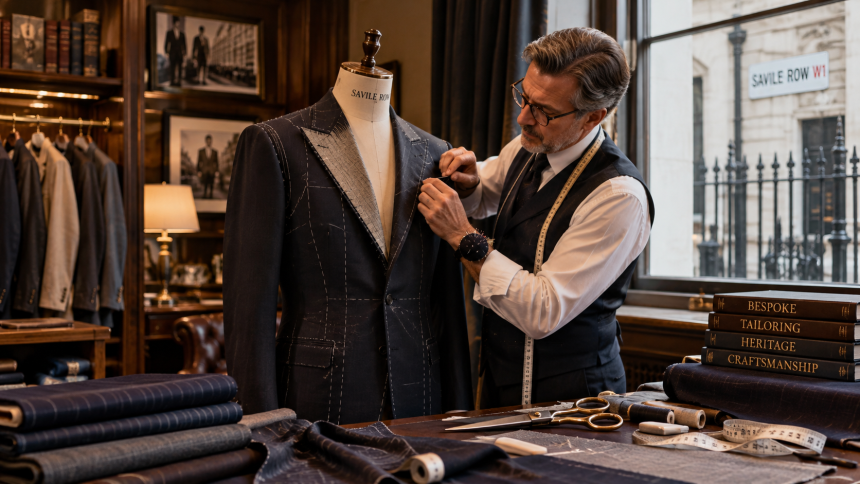
A first-person look inside our Our Savile Row Atelier the fittings, the fabric arguments, the mistakes clients make, and why bespoke still matters.
Someone asked me last week why anyone still bothers with our Savile Row atelier when you can order a decent suit online in three clicks. Fair question.
I didn’t have a tidy answer, if I’m honest I just started talking about wool, and shoulders, and the way a jacket sits differently on a man who’s been properly measured versus one who’s been guessed at. Twenty minutes later she still wasn’t fully convinced, but she’d stopped checking her phone. That’s usually how it goes.
I’ve spent enough years cutting cloth in this stretch of Mayfair that I’ve stopped noticing the tourists photographing the shopfronts. But every so often someone new walks in, a little nervous, clearly expecting something stuffy and old-fashioned, and I get to watch that expectation fall apart in real time.
So let’s talk properly about what actually happens inside a working Savile Row atelier not the postcard version, the real one.
What Walking Into Our Savile Row Atelier Actually Feels Like
Here’s the thing nobody tells you beforehand: it’s quieter than you’d expect. No music, mostly. Just the occasional snip of shears and someone pressing a seam three rooms over. Clients often lower their voices the first time, like they’ve wandered into a church by accident.
The room itself is deliberately unglamorous in places bolts of cloth stacked to the ceiling, a workbench that’s seen sixty years of chalk marks. We could dress it up more for Instagram. We don’t, mostly because the atelier was never built for photographs; it was built for cutting patterns that fit one specific human being and nobody else.
The First Five Minutes Matter More Than People Think
I’ve noticed something odd over the years the clients who end up happiest with their first suit are rarely the ones who arrive with a Pinterest board. They’re the ones who just start talking. About a wedding, a job change, a father’s old jacket they still can’t fit into. That conversation tells me more than any tape measure will.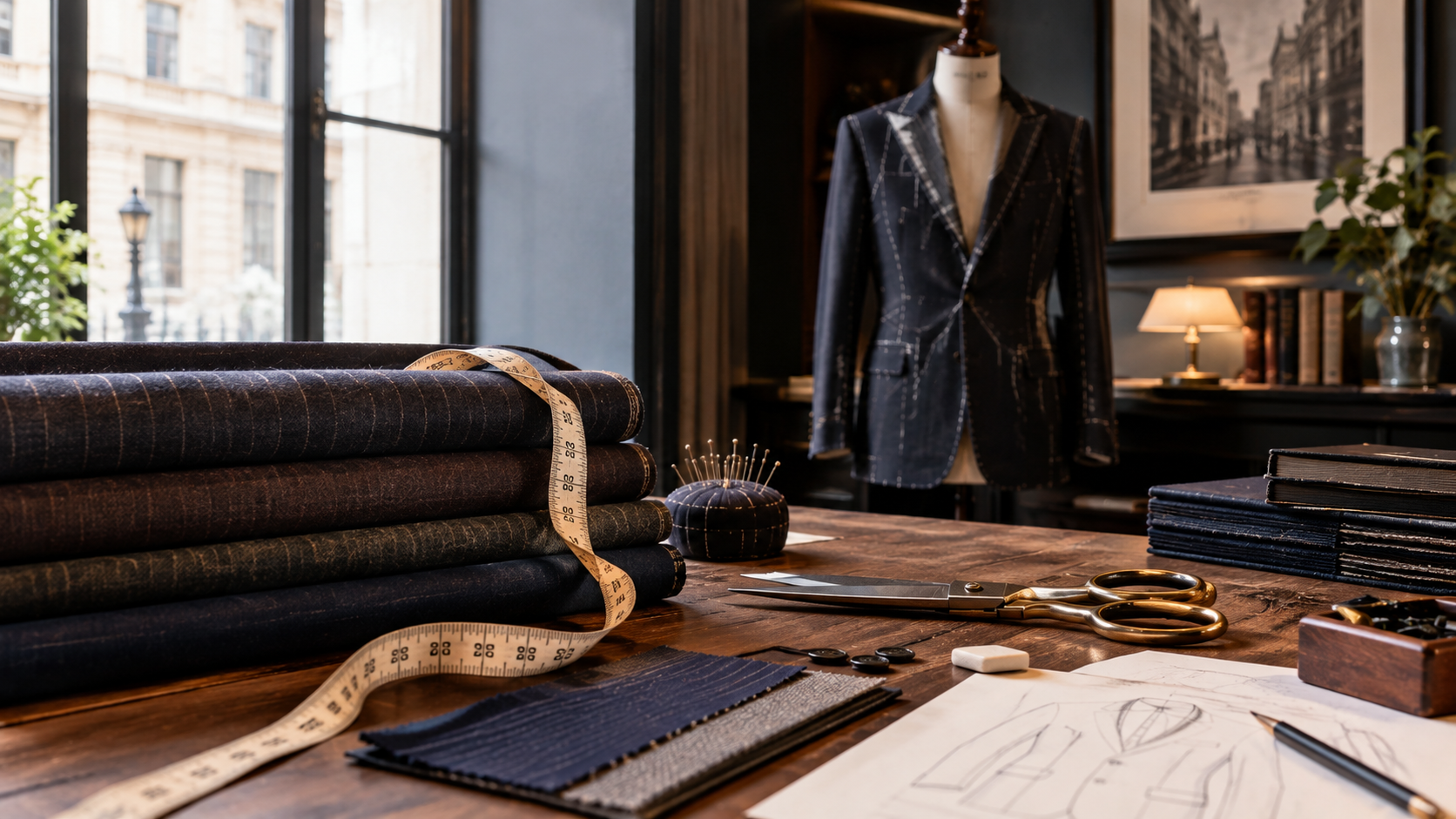
Why We Never Rush the First Consultation
A lot of tailoring houses treat the consultation like paperwork get through it fast, onto the fun part. We don’t, and honestly it’s cost us a booking or two from people who wanted something quicker. That’s fine by me.
The Questions We Ask Before Fabric Even Comes Out
Before anyone touches a swatch book, I want to know how someone actually lives. Do they sit at a desk nine hours a day or stand through meetings? Do they drive or take the Tube?
It sounds like small talk, but a jacket cut for a man who spends his week hunched over a laptop needs a different shoulder line than one cut for someone constantly on his feet. Skip this step and you get a beautiful suit that fights the body wearing it.
Reading a Client’s Life, Not Just Their Measurements
This is the bit I genuinely love, and I’ll admit it’s a little unconventional. A shirt collar that’s slightly looser for someone who’s about to lose weight deliberately. A slightly deeper armhole for a client who golfs every weekend. None of this shows up on a tape measure — it comes from listening, and frankly from asking the occasionally nosy question.
The Fitting Process My Honest Take on Why It Takes So Long
People assume the slowness is theatre. It isn’t. A proper bespoke garment moves through several distinct fittings, and skipping any one of them shows up later, usually in a shoulder that pulls or a collar that gaps at the back.
The Baste Fitting Nobody Warns You About
The first fitting is held together with loose white thread and looks, frankly, a bit alarming. Sleeves are only tacked on. There’s no lining. Clients occasionally panic a little, and I don’t blame them it looks unfinished because it is unfinished, on purpose. This stage exists purely to check proportion and balance before a single permanent stitch goes in.
Second and Third Fittings Where the Real Refinement Happens
By the second fitting, the canvas is properly in and the shape starts reading as an actual jacket rather than a draft. This is usually where I catch the small stuff a lapel that wants to roll slightly differently, a trouser break that’s half a centimetre off.
Some clients need a third round. A few, notoriously fussy about fit, have needed more than that, and I’ve never once minded. That fussiness is exactly what separates bespoke from everything else.
Fabric Choices We Keep Coming Back To (And a Few I Steer People Away From)
Clients often arrive fixated on a fabric they saw somewhere usually something too flashy or too delicate for how they’ll actually wear the finished piece. I’ll say this plainly: a stunning cloth that can’t survive a British commute isn’t doing anyone favours.
Heavier English worsteds tend to be my default recommendation for a first commission, mostly because they forgive a season or two of hard wear while still holding a crisp line.
Lighter fresco weaves are wonderful too, but I’d keep those for a second or third suit once someone’s figured out their own rotation. There’s no universally “correct” cloth just the right one for the life the garment’s actually going to live.
Building a Wardrobe Across the Seasons
First commissions almost always skew heavier than they need to, because clients associate “quality wool” with weight. A 13oz cloth feels substantial in the hand, sure, but wear it through a warm September client meeting and you’ll regret every ounce.
I generally nudge people toward something in the 10 to 11oz range for a genuinely year-round piece heavy enough to hold structure, light enough not to punish you for six months of the calendar.
Once someone owns two or three pieces, that’s when the fun starts. A crisper cotton-linen blend for high summer. Something with a whisper of cashmere for the coldest months. None of this needs deciding on day one I’d rather a client build a wardrobe slowly and correctly than rush toward a closet full of suits that all solve the same problem.
Trunk Shows and Clients Who Fly In
Not every client lives within walking distance of the row, obviously. We run periodic trunk shows in a handful of other cities, and it’s oddly become one of my favourite parts of the job cramming a full consultation, measuring, and sometimes a fitting into a single hurried afternoon in a hotel suite that smells faintly of room service.
It’s less romantic than the atelier itself, but the tailoring standard doesn’t drop just because the room has better carpet than character.
Hand-Stitching Versus Machine Where We Actually Draw the Line
I get asked constantly whether everything in a bespoke suit is hand-sewn, and the honest answer is: mostly, but not obsessively so for its own sake. Certain seams genuinely benefit from machine strength they take more strain and don’t need the give that hand-stitching provides.
But the collar, the lapel roll, buttonholes those stay entirely hand-finished, because machine work simply can’t replicate the softness a trained hand gives a lapel.
This is where I’ll admit to a personal bias: I judge a jacket by its buttonholes before almost anything else. A rushed buttonhole tells you everything about how much care went into the rest of the garment, whether the maker meant it to or not.
The People Behind the Cloth Nobody Does This Alone
Here’s something that surprises almost every new client: the person who takes your measurements almost never sews your entire garment. Bespoke tailoring is a relay, not a solo act. A coat maker builds the jacket. A trouser maker, separately, builds the trousers, often in an entirely different room.
A finisher does the buttonholes and hand details. The cutter the person you actually spend time with drafts the pattern and oversees the whole thing like a conductor who occasionally also plays an instrument.
I mention this because it explains a lot about the pricing and the timeline both. You’re not paying one person for their hours. You’re paying for a small chain of specialists, each of whom trained for years before being trusted with a single stitch on a paying client’s cloth.
That training, by the way, isn’t quick apprenticeships in this trade traditionally run five to seven years before someone’s allowed to cut independently. I still remember how long it took before anyone let me near a client’s actual cloth unsupervised, and honestly, looking back, that caution was completely justified.
Why Slow Training Still Matters
There’s a temptation in any craft to speed up training once demand outpaces supply. We’ve resisted that, mostly because a half-trained cutter’s mistakes don’t show up immediately they show up eighteen months later, when a shoulder seam that looked fine on day one starts pulling because the balance was never quite right to begin with.
Slow training is annoying in the short term and saves everyone grief in the long term.
How We Actually Price a Commission (The Honest Version)
Nobody enjoys talking about cost, and tailors are historically terrible at explaining it clearly, so let me try. A bespoke two-piece suit from a proper Savile Row house typically starts somewhere in the low thousands and climbs from there depending on cloth, complexity, and how many fittings a particular client genuinely needs.
What you’re paying for isn’t fabric fabric is often a smaller slice of the bill than people assume. You’re paying for hours. Dozens of them, spread across cutting, basting, fitting, unpicking, re-cutting, and finishing by hand. A jacket that’s cut, fitted, unpicked, and remade twice has had more human attention poured into it than most furniture in your home.
I won’t pretend this makes bespoke accessible to everyone, because it doesn’t, and I’m not going to insult anyone’s intelligence pretending otherwise. What I will say is this: cost per wear tells a different story than sticker price. A well-made suit worn weekly for fifteen years works out cheaper, per outing, than a string of cheaper suits replaced every eighteen months because the shoulders gave out.
What Actually Separates Savile Row From Made-to-Measure
People use “bespoke” and “made-to-measure” interchangeably, and it genuinely bothers tailors more than it should. Made-to-measure starts from an existing block pattern and adjusts it. Bespoke starts from nothing a pattern drafted from scratch, for one person, kept on file indefinitely.
The distinction between the two traditions runs deep enough that it’s shaped the entire identity of Savile Row’s tailoring reputation, and honestly, once you’ve felt the difference in how a garment moves with you rather than around you, going back is hard.
The street itself has a longer, stranger history than most people realise too a Mayfair address that’s hosted everything from British military tailoring during wartime to a rooftop Beatles concert, which is a genuinely odd bit of trivia I bring up more than I probably should during quiet fittings.
A Fairly Ordinary Day Inside the Workroom
People imagine something quite grand when they picture a day here, and the reality’s a lot scruffier and more interesting. Mornings usually start with chalk and paper drafting or adjusting a pattern before anyone else arrives, because that work genuinely needs silence.
By mid-morning it’s fittings, one after another, each requiring a slightly different mood depending on the client. Some want conversation. Some want quiet concentration and appreciate not being small-talked at while standing in their socks.
Afternoons tend to be workroom time checking a coat maker’s progress, correcting a baste before it goes further, occasionally unpicking something that looked fine on paper but sits wrong on an actual shoulder. T
here’s a lot of undoing in this trade that nobody talks about publicly. Cutting cloth is the glamorous part. Unpicking a seam you got slightly wrong, twice, humbly, is most of the actual craft.
By early evening someone’s usually sweeping thread and offcuts off the floor, and there’s always at least one half-finished jacket draped over a dummy, waiting for tomorrow. It’s less cinematic than people expect and, honestly, a lot more satisfying than the postcard version ever manages to capture.
Common Misconceptions Clients Walk In With
The biggest one, by a wide margin: that bespoke tailoring is only for suits. It’s not. We cut shirts, overcoats, waistcoats, even the occasional dinner jacket for something that isn’t strictly black tie.
Someone tried to order a bespoke gilet once for a shooting weekend, and honestly, it turned out beautifully proof that the process works for almost anything structured.
The second misconception is about turnaround. People expect same-week service because that’s what ready-to-wear has trained them to expect. A proper commission takes months, not days, and that timeline exists for a reason it’s the fittings, not the fabric, that eat the calendar.
A third, smaller one worth mentioning: people assume bespoke means rigidly traditional, as if every jacket has to look like something from a 1950s portrait. It doesn’t.
We’ve cut slim, modern silhouettes for younger clients who wanted something closer to what they’d see on a well-dressed friend than a grandfather’s wardrobe. Tradition, in this trade, is mostly about process and craftsmanship not about forcing everyone into the same cut.
Caring for a Bespoke Piece Once You Actually Own One
A jacket this carefully made deserves slightly more care than tossing it over a chair. Hang it on a proper wooden hanger, always — wire ones distort the shoulder line faster than you’d think. Brush it down after wear instead of dry-cleaning constantly; over-cleaning breaks down the canvas structure years before it should wear out.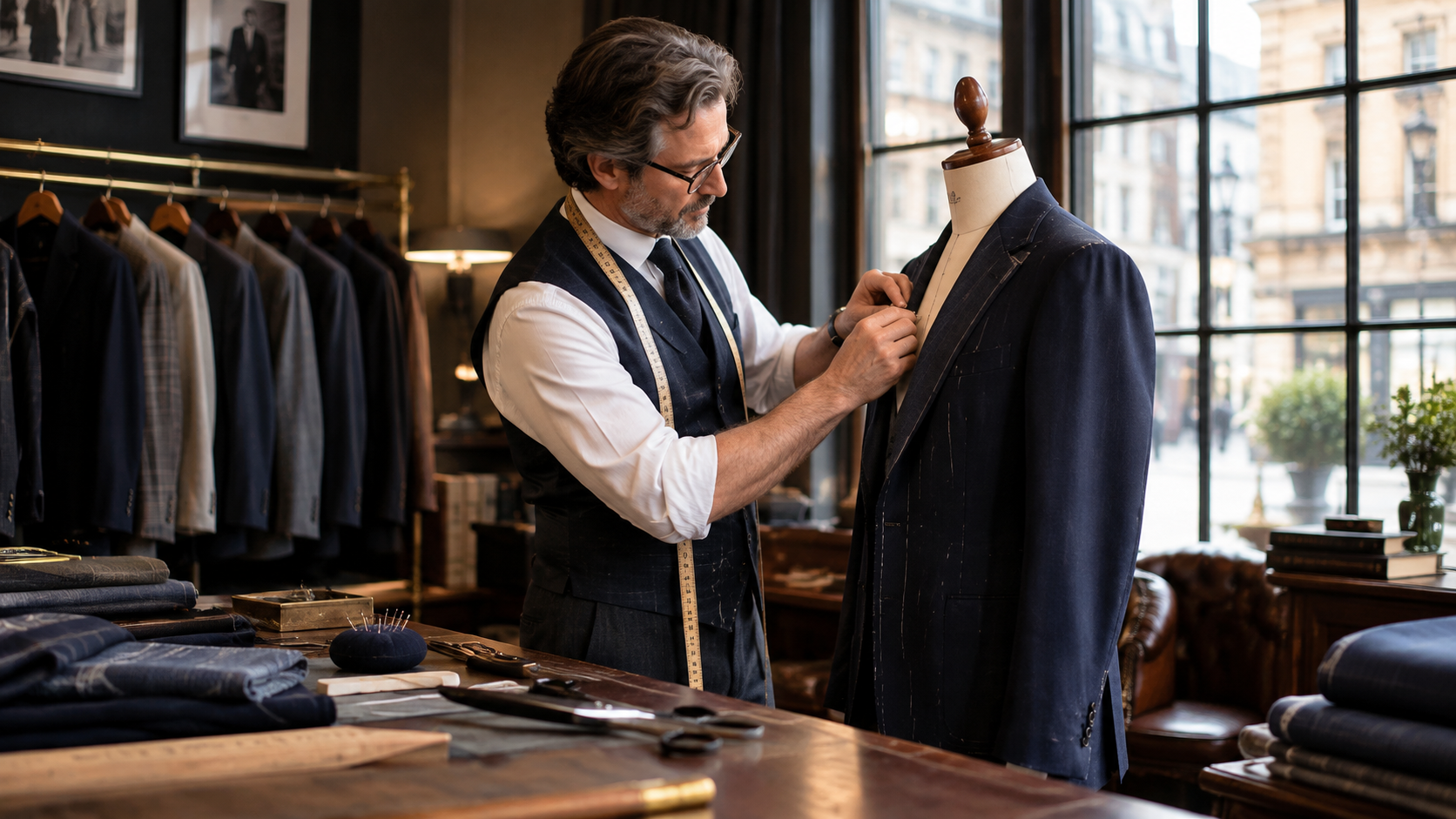
Rotate your suits if you wear one often. Wool genuinely needs rest between wears to recover its shape, and a well-made garment given proper rest can outlast the person who commissioned it I’ve re-altered jackets originally cut for a client’s father, decades apart, and the cloth held up better than either generation expected.
A Suit’s Second Life, Third Life, and Beyond
This is the part of the job people underestimate most: bespoke pattern retained on file means alterations decades later aren’t guesswork. Someone gains weight, loses it, has a hip replaced, whatever life throws at them bring the jacket back and we’re letting out a seam using the exact original pattern, not eyeballing it from scratch.
I’ve re-cut a waistband four separate times for one particular long-standing client, and every single time it fit as though it had been made yesterday.
Inherited pieces are their own category entirely, and honestly one of the more moving parts of the work. Someone brings in their late father’s jacket, cut here thirty years earlier, hoping it can be resized for them. Sometimes it can.
Sometimes the cloth’s simply too far gone, and that’s a hard conversation to have. But when it works, watching someone step into a garment that’s outlived one owner already that’s not something a fast-fashion suit will ever offer anyone.
Where Bespoke Actually Fits Into the Slow Fashion Conversation
I’ll be honest, I used to roll my eyes slightly at “sustainability” being applied to a £4,000 suit it felt like a marketing bolt-on. I’ve mostly come around.
A garment built to be repeatedly altered rather than replaced, worn for decades instead of a handful of seasons, genuinely does less damage over its lifetime than a cheaper suit bought three or four times over the same period. That’s not spin, it’s just arithmetic once you actually chart cost and waste against years of wear.
That said, I won’t pretend bespoke solves fashion’s bigger waste problem on its own it’s a niche answer to a mass-market issue, and anyone telling you otherwise is overselling it.
What it does offer is a genuinely different relationship with clothing: fewer pieces, each one meant to be kept, repaired, and handed down rather than binned the moment a trend shifts.
Who We Actually Make For, Beyond the Cliché
The stereotype is bankers and diplomats, and sure, some of that’s accurate. But honestly the client list is far stranger and more interesting than people assume musicians who need a stage jacket that survives sweat and movement, academics who want one good suit to last fifteen years, brides commissioning a tailored suit instead of a traditional gown.
Once a commission gets that personal, oddly specific requests and all, it’s usually the one I end up enjoying most.
What a Trained Eye Catches in the First Ten Seconds
I’ll admit this is a slightly annoying habit, but I can’t switch it off anymore I size up nearly everyone I meet within about ten seconds, purely on instinct. Collar gap at the back of the neck. A sleeve that ends half an inch too long.
Trousers breaking wrong over the shoe. None of it’s judgment, honestly, it’s just years of pattern recognition running on autopilot.
What surprises people most is how small the actual fixes usually are. A collar that gaps isn’t a disaster requiring a whole new jacket — it’s often a quarter-inch adjustment at the back seam that a decent tailor can sort in one sitting. The gap between “this fits badly” and “this fits perfectly” is almost always narrower than people assume, which is honestly good news for anyone nervous about the whole process.
The Shoulder Test I Use on Almost Every Client
Here’s a small trick, free of charge: raise both arms slightly forward, like you’re about to shake someone’s hand, and watch what the jacket does across the back. A well-cut jacket barely moves. A poorly cut one pulls, creases, or rides up at the collar. I do this with every single fitting, sometimes twice, because it catches balance issues that standing still simply won’t reveal.
Questions I Wish More Clients Asked Before Ordering
Most people ask about price and timeline, understandably, and then stop there. A few questions I genuinely wish came up more often: How many total garments will this cloth realistically pair with in my existing wardrobe?
Will this weight of wool actually suit my daily routine, not just the season on the calendar? What happens if my body changes significantly in the next few years?
That last one especially. Bodies change weight shifts, posture shifts, sometimes a client takes up rowing and suddenly needs room through the shoulders they didn’t need eighteen months earlier.
A bespoke pattern accounts for this far better than people expect, precisely because it’s kept on file rather than thrown away after one use. Asking about it upfront just means fewer surprises down the line, and honestly, I’d rather field the awkward question at the consultation than the disappointed one at collection.
What I’d Tell Someone Ordering Their First Suit
Don’t over-plan the details before your first meeting. Come with a rough sense of what you need it for, and let the conversation shape the rest. And don’t be embarrassed about asking “silly” questions I promise every tailor here has heard stranger ones than whatever’s on your mind.
It’s a lengthy piece worth reading if you want a fuller sense of the whole process and what to expect from a guide for men navigating their first bespoke commission before walking in.
A Few Terms Worth Knowing Before Your First Visit
Walking into a fitting room without knowing the vocabulary can feel intimidating, so here’s the short version of the words that come up constantly:
- Baste the loosely stitched, unfinished version of a garment used for the first fitting.
- Canvas the internal structure inside a jacket’s chest and lapel that gives it shape and roll, sitting between the outer cloth and the lining.
- Drape how a garment hangs and moves on the body, rather than how it looks static on a hanger.
- Lapel roll the soft curve of a lapel as it folds away from the chest, ideally shaped by hand rather than pressed flat.
- Bespoke a garment cut from an entirely new pattern drafted for one specific person, as opposed to an adjusted existing block.
None of this is essential knowledge going in we’ll explain everything as we go but it tends to make that first conversation feel a little less like a foreign language.
Frequently Asked Questions
How long does a bespoke suit from our Savile Row atelier actually take?
Most commissions take between eight and twelve weeks, sometimes longer depending on fittings and fabric availability. Rushing the process usually shows up in the final fit, so we’d rather deliver it right than deliver it fast.
Do I need multiple fittings, or can I skip straight to a finished garment?
Fittings aren’t optional if you want a genuinely bespoke result they’re how proportion and balance get corrected before permanent stitching. Most clients go through two or three; a few need more, and that’s completely normal.
What’s the real difference between bespoke and made-to-measure tailoring?
Made-to-measure adjusts an existing pattern block to your size. Bespoke drafts an entirely new pattern from scratch, cut and fitted specifically to you, and kept on file for future commissions.
Can women commission bespoke pieces at our atelier?
Yes, absolutely bespoke tailoring for women has grown significantly in recent decades, and it’s now a regular part of what we do, from tailored suiting to occasionwear.
How should I care for a bespoke suit to make it last?
Use a proper wooden hanger, brush it rather than over-clean it, and give it rest days between wears. Treated well, a bespoke piece can last decades rather than years.
Roughly how much does a bespoke commission cost?
A bespoke two-piece typically starts in the low thousands and rises with cloth and complexity. It’s a bigger upfront number than ready-to-wear, but the cost per wear over a decade or more usually tells a different story.
Can an old bespoke jacket be altered years later, even by a different generation of owner?
Often, yes. Because the original pattern is kept on file, later alterations can be done accurately rather than guessed, which is why bespoke pieces are sometimes passed down and re-fitted across family members.
Final Thoughts
If you’ve read this far, you’re probably more curious about bespoke tailoring than you were ten minutes ago, and that’s honestly the best outcome I could hope for. Our Savile Row atelier isn’t trying to be a museum piece it’s a working room where cloth gets cut for real lives, real weddings, real awkward body proportions that off-the-rack never quite solves.
Come in, ask the questions, don’t be shy about it. We’ve heard stranger ones. And if you’re ready to see what a properly fitted jacket actually feels like, book a consultation and let’s talk fabric.