




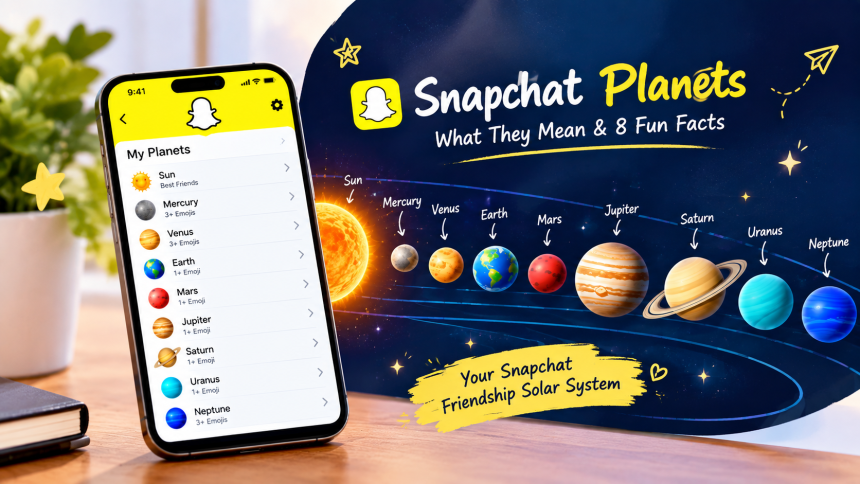
So Snapchat planet meanings on Snapchat confused me for way longer than I’d like to admit. I kept seeing screenshots of little glowing planets next to people’s Bitmojis and had zero idea what any of it meant. Turns out it’s Snapchat’s way of ranking your closest friends using an actual solar system and once you get it, it’s honestly kind of a fun rabbit hole.
I’ve spent a stupid amount of time poking around this feature since it rolled out, mostly because my niece kept asking me why she was “stuck on Neptune” with her best friend. So here’s everything I’ve picked up, no fluff, no pretending I knew this on day one.
What actually got me curious enough to write this up wasn’t the planets themselves it was realizing how much backstory sits underneath a feature that looks, on the surface, like a throwaway cosmetic gimmick.
There’s an entire older emoji system feeding the same data, a genuine controversy that forced Snapchat to redesign how the feature launches, and a handful of quieter mechanics streaks, story replies, region availability that most quick explainers skip right past. So consider this the long version, the one that actually answers the follow-up questions instead of just listing planet names and calling it done.
What Even Is the Snapchat Solar System?
Here’s the basic idea: you’re the sun, and your closest friends orbit around you as planets. The planet meanings all boil down to one thing how much you actually talk to that person on the app. Snaps, chats, story replies, streaks, all of it feeds into where someone lands.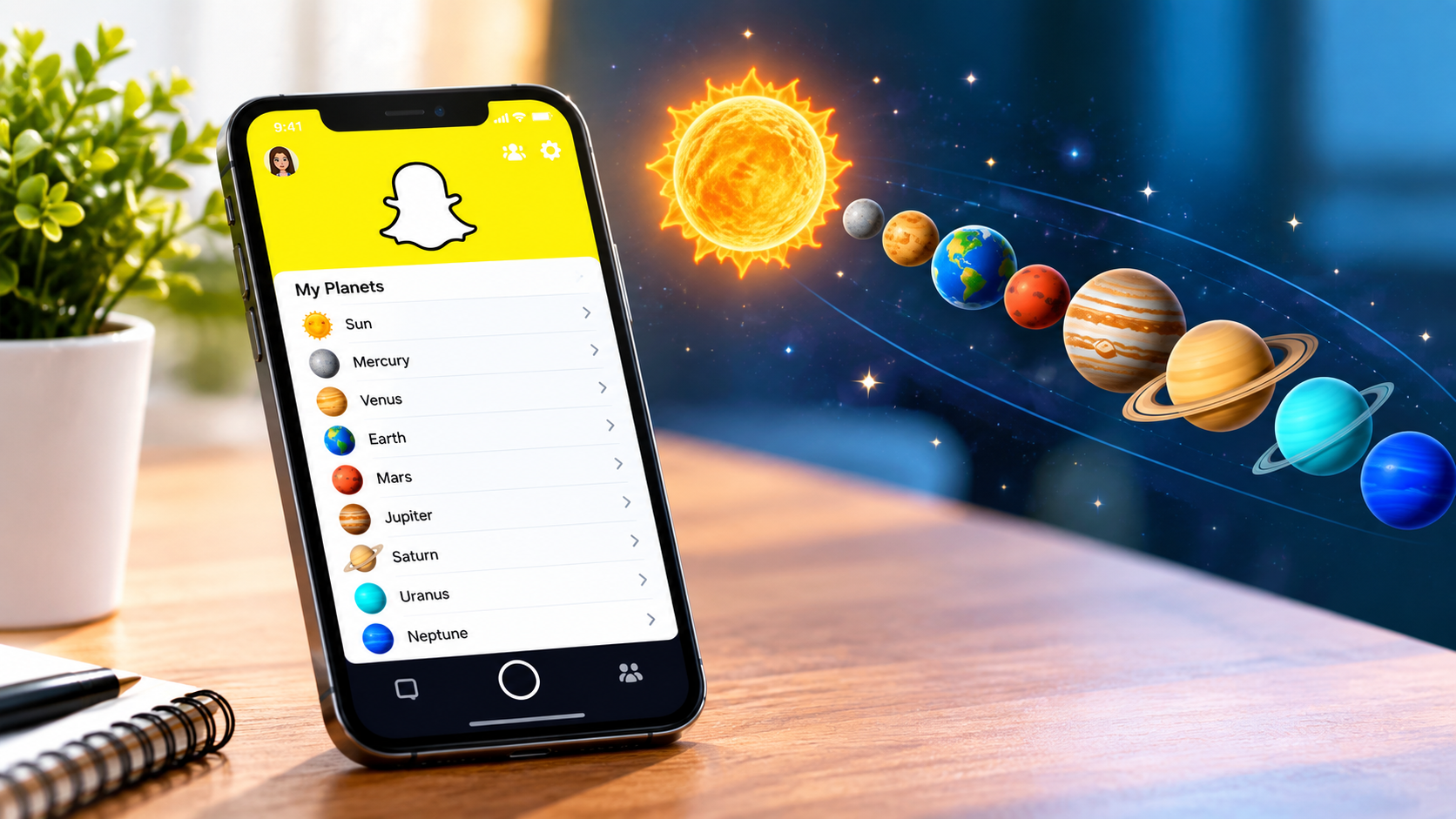
The official name for it is the Friend Solar System, and it’s tucked inside Snapchat Plus rather than being available to everyone. That surprised me at first I figured a feature this popular would just be baked into regular Snapchat, but nope, it’s a paid perk.
Not everyone can see it right away
Even if you’ve got Snapchat Plus, the feature doesn’t just switch on for you. You’ve got to go dig into your profile settings and flip it on yourself, which feels like an odd design choice until you know the backstory and I’ll get to that in a second, because it’s actually the most interesting part of this whole thing.
Snapchat Planets in Order, Explained
This is the part everyone actually searches for, so let’s just go through it plainly.
Mercury through Mars
Mercury is your number one the friend you snap and chat with more than anyone else. It shows up as a reddish planet surrounded by little hearts, which is a nice touch honestly.
Venus takes the second spot, Earth the third, and Mars the fourth. As you move down that list, the visual flair starts fading fewer hearts, less sparkle which I actually think is a smart bit of design. It quietly tells you where you stand without spelling it out in a number.
Jupiter down to Neptune
Jupiter’s fifth, Saturn’s sixth, Uranus is seventh and shows up as a plain green globe, and Neptune rounds things out at eighth. Nobody wants to be someone’s Neptune my niece made that very clear to me but functionally it just means you’re still in their top eight, only near the bottom of it. That’s still closer than the other 400 people someone might follow, so I’d argue it’s not the insult it feels like.
How Does Snapchat Actually Decide Your Planet?
This is where people get it wrong a lot, in my experience. It’s not about how long you’ve known someone or how close you actually feel to them emotionally it’s purely activity-based. Snaps sent, chats exchanged, streaks kept alive, story replies. That’s it.
It updates constantly, which trips people up
Your planet meanings shift as your habits shift. Go quiet with someone for a couple weeks and you’ll likely slide down their solar system even if nothing’s actually wrong between you two. I’ve noticed this causes way more unnecessary drama than it should a dip in Mercury-to-Venus doesn’t mean somebody’s mad at you, it usually just means life got busy.
The algorithm doesn’t care about your feelings
Here’s the thing most people miss: this is a frequency tracker dressed up as astronomy, not a friendship scorecard. Snap knows this too, actually which is exactly why the feature almost didn’t survive its first launch.
Before Planets: The Original Snapchat Friend Emojis
Here’s something a lot of the planet guides skip over entirely, and honestly it’s the part that made the whole system click for me planets didn’t come out of nowhere. Snapchat’s been ranking friendships with little symbols for years before the Solar System ever existed, and that older emoji system is still running alongside it today.
The yellow heart everyone chases
If you’ve used Snapchat for more than five minutes, you’ve probably seen a yellow heart 💛 pop up next to someone’s name. According to Snapchat’s own support documentation, that means you sent the most Snaps to that person, and they sent the most Snaps back to you it’s mutual, both directions have to line up. Miss that mutual part and you get something else entirely, which trips a lot of people up.
What happens when it’s one-sided
If you’re someone’s top contact but they’re not yours, Snapchat used to show a smirking face 😏 to flag the mismatch. That emoji’s since been retired, which honestly feels like a mercy nobody needs a little smirking cartoon face rubbing in an unbalanced friendship.
These days a smiley face 😊 covers the more general “you’re one of their best friends, just not the top one” situation instead.
The loyalty tiers: red hearts and pink hearts
Keep that yellow heart mutual status going for two straight weeks and it upgrades to a red heart ❤️. Hold onto that for two full months and you get two pink hearts 💕 Snapchat’s version of a long-service award, basically.
There’s also a grimacing face 😬 for when your top best friend and someone else’s top best friend happen to be the same person, and a sunglasses face 😎 when you two simply share a mutual best friend without the direct overlap.
Streaks are a separate thing entirely
I used to think the fire emoji 🔥 was part of the same ranking system as the hearts, but it’s not Snapstreaks track daily consecutive Snaps between two people, completely separate from who ranks where on your best friends list.
You can have a roaring streak with someone who barely cracks your top eight, and zero streak at all with your actual yellow heart. The hourglass ⌛ shows up when a streak’s about to expire, and from what I’ve read you generally get a few hours’ grace period before it resets to zero, which has caused more mild panic among teenagers than probably any other emoji Snapchat’s ever shipped.
So how does this connect to planets?
Functionally, the planets and the emojis are measuring the exact same underlying data who you snap and chat with most just presenting it two different ways.
The emoji system is free and shows up for everyone automatically. The Solar System is the flashier, more visual version locked behind a Snapchat Plus subscription. If you’ve ever wondered why your yellow-heart friend also happens to be sitting on Mercury in your solar system, that’s why same signal, different costume.
A Few More Emojis Worth Knowing
Since we’re already deep into the emoji weeds, a couple more show up often enough that they’re worth a quick mention, even though they’re not directly about ranking closeness.
The gold star and the birthday cake
A gold star 🌟 shows up when someone’s replayed your Snap within the past day it’s less about friendship depth and more just a little signal that your content landed.
A birthday cake 🎂 shows up on someone’s profile when it’s their actual birthday, assuming they’ve added that info to their account. Neither of these affects your planet or your friend emoji at all; they’re informational extras layered on top.
Zodiac emojis
If a friend’s added and shared their birthday, you might also see a small zodiac symbol next to their name instead of, or alongside, the usual friendship emoji. It’s purely cosmetic and tied to their birth date, nothing to do with activity.
You can actually customize these
Here’s something a lot of people don’t realize: you’re not stuck with Snapchat’s default icons. Under Settings, there’s a Customize Emojis option that lets you swap which symbol represents each friendship tier for your own view.
Changing the icon doesn’t change how the underlying system calculates anything it’s purely cosmetic, so if you’d rather see a different symbol than a yellow heart for your top friend, you can, without messing with the actual ranking logic underneath.
What’s Next for the Solar System Feature
Snapchat’s clearly still tinkering with this corner of the app, and a few smaller additions have been floated or spotted in testing that are worth flagging, even though none of them change the core mechanics.
Smoother animations and reactions
Recent updates have focused on making the planets feel a bit more alive smoother transition animations when someone’s position shifts, plus small Bitmoji reaction touches inside the Solar System view itself. Nothing groundbreaking, but it fits Snapchat’s general pattern of iterating on visual polish for features that already have an established audience.
Possible badge rewards for consistency
There’s been chatter about a “Galaxy Badges” concept in testing essentially a reward layer for maintaining consistent interaction with close friends over time, sitting on top of the existing planet system rather than replacing it.
I’d take this one with a grain of salt until it’s officially confirmed and rolled out widely, since features spotted in testing don’t always make it to a full release in the same form.
My honest read on where this is headed
Snapchat’s clearly leaning into the “gamify your social graph” idea rather than backing away from it, opt-in fix aside. That’s probably the right call commercially people evidently like seeing this stuff, controversy included but I’d keep an eye on how any new addition handles the same privacy and pressure concerns that forced the original opt-in change in the first place.
Why Snapchat Made This Feature Opt-In
This bit doesn’t get talked about enough, and it’s genuinely the most important context for understanding why the Solar System works the way it does today.
Teens didn’t take the rankings well
When Snapchat first tested this feature, it was switched on by default. Almost immediately, reporting on the rollout flagged that teen users were finding it stressful seeing yourself ranked low, or watching your position slip, added a layer of social comparison that a lot of younger users just weren’t prepared for.
Snap’s own response acknowledged the feature was “not visible to other friends” and wasn’t meant as a public ranking, but that distinction didn’t stop it from stinging privately.
Snap actually walked it back
To their credit, the company didn’t just shrug it off. According to reporting from Axios, Snapchat announced it would make the feature something users had to actively turn on rather than something forced on everyone by default, specifically citing feedback about the emotional impact on younger users.
That’s a pretty rare move for a social platform, and I’ll admit it bumped my opinion of the company up a notch. Most apps double down on engagement features even when they’re clearly causing stress; Snap actually adjusted course here.
Why this matters if you’re a parent
If you’ve got a teenager on Snapchat, it’s genuinely worth knowing this backstory before assuming the feature’s harmless just because it looks like a cute space theme. The concern that drove Snapchat’s opt-in change wasn’t hypothetical it came from real reporting on how visible social ranking affected younger users’ sense of belonging.
My honest take: the opt-in fix helps, but it doesn’t eliminate the dynamic entirely, since kids still compare notes with each other about who’s on whose Mercury. Worth a conversation, not necessarily a ban.
What that means for you today
So if you’re a new Snapchat Plus subscriber wondering why you can’t see any planets at all, that’s why it’s intentionally off until you flip it on yourself. According to Snapchat’s own support documentation, the Solar System stays private too, meaning your friends can’t see your full rankings, only their own specific position when they check your profile badge.
Common Myths About Snapchat Planets
I keep seeing the same wrong ideas repeated in comment sections, so let’s clear a few of these up directly.
Myth: your planet is permanent
It’s not. Planets shift as your activity shifts, sometimes within days. Someone parked on Mercury today can slide down within a week or two if the conversation naturally cools off, and that’s completely normal it’s not a sign anything’s wrong.
Myth: everyone can see your whole solar system
Nope. Per Snapchat’s own documentation, your full Solar System is private to you. Friends only ever see their individual position when they check the badge on your profile they can’t browse your entire ranked list like some kind of leaderboard.
Myth: paying for Snapchat Plus boosts your ranking
Subscribing just unlocks visibility into the feature. It doesn’t change the underlying math at all you can’t buy your way to Mercury. The ranking is still driven purely by actual Snap and chat activity between you and the other person.
Myth: the feature tracks who you talk about, not who you talk to
Some people assume Snapchat’s somehow reading conversation content for sentiment. It’s not doing anything like that — it’s purely counting interaction volume: Snaps sent, chats exchanged, story replies, streaks. Nothing about tone, nothing about what’s actually said.
How Snapchat’s Ranking Stacks Up Against Other Apps
It’s worth zooming out for a second, because Snapchat isn’t the only platform quietly ranking your closeness to other people it’s just unusually upfront about showing you the result.
Instagram’s Close Friends list
Instagram’s Close Friends feature works in the opposite direction you manually choose who goes on the list rather than an algorithm deciding for you. It’s a curated green-ring group for private Story posting, not a ranked order, so there’s no Mercury-versus-Neptune anxiety built into it. I actually prefer that model for reducing social pressure, even if it’s less fun to poke around in.
BeReal and the “friends of friends” layer
BeReal never publishes a ranked friend list at all, but its whole feed design nudges you toward posting for a smaller, closer circle rather than a broad public audience. Different mechanism, similar underlying goal surfacing your actual close connections instead of your entire follower count.
Why Snapchat’s version generates more buzz
The reason Snapchat’s Solar System gets talked about so much more than either of those is pretty simple: it’s the only one of the three that actively ranks people in a visible order and represents it with a fun, shareable visual.
Curated lists don’t create the same “wait, am I his Mars or his Jupiter” curiosity that a numbered planetary order does. That’s honestly good product design from an engagement standpoint, even with the emotional baggage that comes attached to it.
How to Check Where You Rank With a Friend
You don’t need a menu buried five taps deep for this one, which I appreciated.
Head to a friend’s profile and look for the little colored badge near their name Best Friends or Friends. Tap it, and it’ll reveal your planet in their solar system. A Best Friends badge means you’re in each other’s top eight; a Friends badge means you’re in theirs, but they haven’t cracked yours. That distinction annoyed me the first time I noticed it on my own profile, not going to lie.
What Snapchat Plus Actually Costs
Since the Solar System sits behind a paywall, it’s worth knowing what you’re actually signing up for before you go hunting through settings looking for planets that won’t appear.
Pricing and what else you get
Snapchat Plus runs at a low monthly cost commonly cited around $3.99 a month, though pricing can shift by region and occasionally by promotion.
The Solar System is just one perk bundled into a bigger subscription that also includes things like Priority Replies, which bumps your replies higher in a Snap Star’s story replies, plus extra Bitmoji customization options and a few exclusive app icons.
So even if the planets aren’t your main draw, you’re not paying purely for a friendship ranking chart there’s a handful of smaller perks layered in with it.
Where it’s actually available
The feature isn’t global yet. It’s been rolled out to a growing list of countries reporting has put the number somewhere north of 25 supported regions so if you’ve got Snapchat Plus but still can’t find the Solar System option anywhere in your settings, region restriction is the most likely reason, not a bug on your end.
Tips If You Actually Want to Climb the Rankings
I’ll be honest, I don’t think chasing a higher planet is a great use of anyone’s energy, but if you’re curious how people actually move up, here’s what the mechanics reward.
Consistency beats intensity
A slow, steady stream of daily Snaps and chat replies tends to matter more than the occasional huge burst of activity. The system’s tracking a pattern, not a single big day.
Streaks quietly help
Since keeping a Snapstreak alive means you’re sending an actual camera Snap every single day without fail, it naturally feeds into the same activity signal that decides planet placement even though streaks and planets are technically separate systems under the hood.
Story replies count too
Don’t sleep on this one. Reacting to someone’s Story or replying to it isn’t just a courtesy it’s activity data feeding straight into their sense of who’s actually engaged with them.
Forcing it usually backfires
Here’s my honest opinion: sending a friend twenty pointless black-screen Snaps a day just to chase Mercury is going to feel hollow fast, both for you and for them. The friendships that land on the closer planets naturally tend to be the ones where the effort isn’t calculated in the first place.
Should You Actually Care About Your Planet?
Honestly? Not that much. I say this as someone who definitely refreshed a friend’s profile more than once just to see if I’d moved up.
It’s activity, not affection
The ranking reflects how much you’re snapping, not how much someone values you as a person. Plenty of close friendships run mostly through phone calls or in-person hangouts rather than a constant stream of Snaps, and those friendships would show up as some distant, unglamorous planet despite being genuinely solid.
Streaks can skew things
One quirk worth knowing: because streaks count toward your ranking, someone you keep a long streak with purely out of habit might outrank someone you actually talk to more meaningfully through longer conversations. That’s a real limitation of the system, and it’s worth remembering before you read too much into anyone’s position.
What Happens When Things Change Between You Two
A few situational questions come up constantly around this feature, so let’s knock them out here rather than leaving them vague.
If you stop talking for a while
Your planet doesn’t vanish instantly. It drifts gradually as your recent activity trends downward, so a week of silence during a busy stretch won’t necessarily tank you from Mercury to Neptune overnight. Give it time before reading too much into a dip.
If you unfriend or block someone
Removing someone from your friends list removes them from your Solar System entirely there’s no ranking left to display once the connection itself is gone. Blocking works the same way; the relationship data effectively resets if you ever reconnect down the line.
If you both go quiet at the exact same time
This one’s oddly common two people slow down snapping each other simultaneously, usually because life just gets busy on both ends, and both notice the shift at once. It reads dramatic in the moment, but it’s almost always coincidental timing rather than either person deliberately pulling back.
Frequently Asked Questions
What does it mean if I’m Mercury on someone’s Snapchat?
It means you’re their number one most-active friend on the app based on snaps, chats, and streaks. It’s the closest position in their Solar System.
Why can’t I see the Solar System feature at all?
You likely need a Snapchat Plus subscription, and even then, the feature stays switched off until you manually turn it on in your settings.
Can my friends see my entire planet ranking list?
No. Your full Solar System stays private friends can only see their own specific planet position when they tap the badge on your profile.
Does being someone’s Neptune mean they don’t like me?
Not at all. It just means you’re their eighth-closest friend by activity, which still puts you ahead of everyone outside their top eight entirely.
Why did Snapchat change how this feature works?
Early versions were switched on automatically, and reports showed the visible rankings were causing anxiety among teen users, so Snapchat made it opt-in instead.
Are the Solar System and the old Snapchat friend emojis the same thing?
They’re separate systems built on the same underlying data. The emojis (yellow heart, red heart, and so on) are free and automatic; the planets are a Snapchat Plus feature with a different visual style.
Does having a Snapstreak guarantee a closer planet?
Not by itself. Streaks feed into the same general activity signal, but overall Snap and chat volume across your whole relationship still determines the final ranking, not the streak count alone.
Final Thoughts
At the end of the day, the planet meanings on Snapchat are a genuinely clever bit of gamified design but they’re measuring snap frequency, not the actual depth of your friendships. I’d say enjoy it for what it is, a fun little visual, and try not to spiral if you slide from Venus to Mars one week.
Go check your own Solar System if you’ve got Snapchat Plus, and maybe don’t read too much into whoever’s sitting on Neptune.
Sources: Snapchat’s official Friend Solar System help page, Snapchat’s official Friend Emoji guide, and Axios reporting on Snapchat’s ranking feature changes.